
Top 19 Marble Black and White Bathroom Elegance Ideas for a Timeless Bath
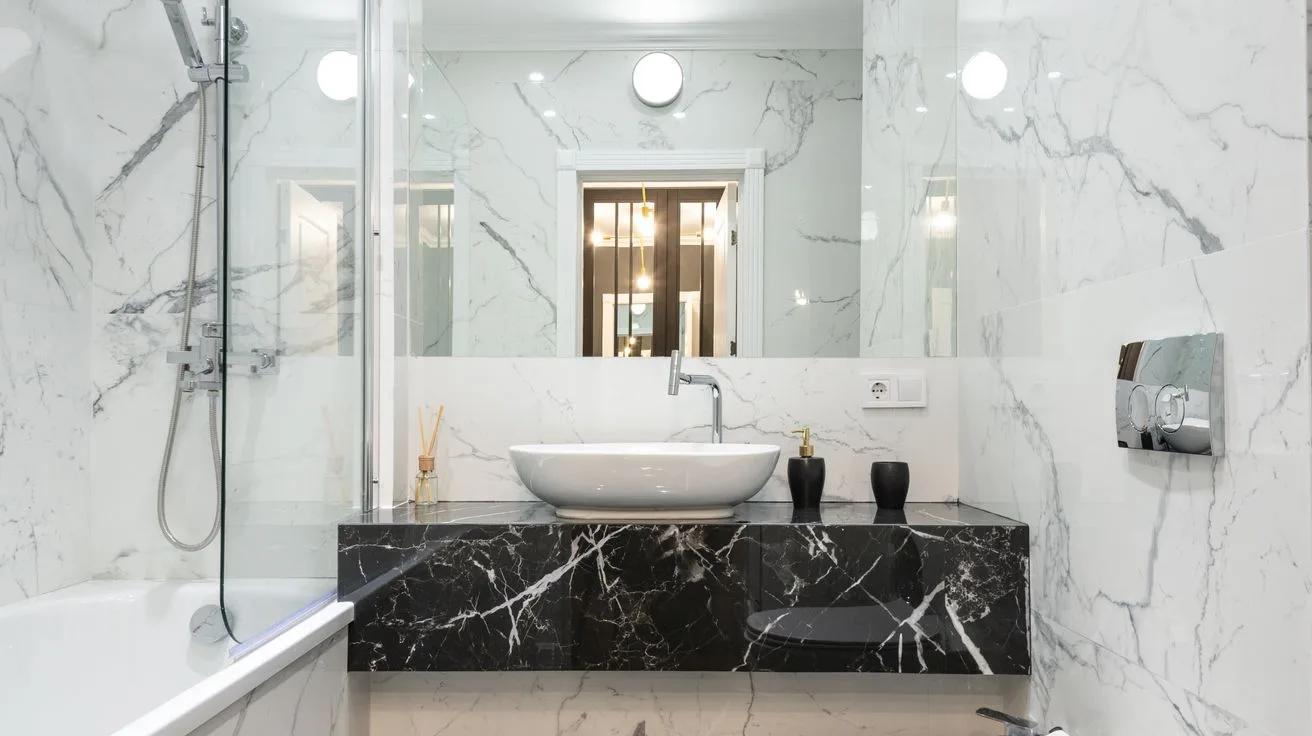
Black and white is the most enduring color pairing in bathroom design, and marble is the material that makes it feel expensive. Put the two together and you get a bathroom that looks calm in the morning, dramatic at night, and timeless in every photo you take of it. Marble black white bathroom elegance is not about filling a room with stone and hoping for the best. It is about balance: white marble to open the room up, black marble to ground it, and the right fixtures to tie the two together.
In this guide you will find 19 marble black white bathroom elegance ideas you can mix, match, and layer, from a full wall of white marble to one black marble counter that changes the whole room. Every idea includes the materials to look for, realistic price ranges, and the styling moves that keep the look elegant instead of cold. You will finish knowing exactly where to put the black marble, where to keep the white marble, and what to skip.
Save this list before your next bathroom refresh. Most of these ideas work at any scale, from a full remodel to a weekend of new hardware, textiles, and styling, and they build on each other, so start with one statement change and let the rest follow.
Overview
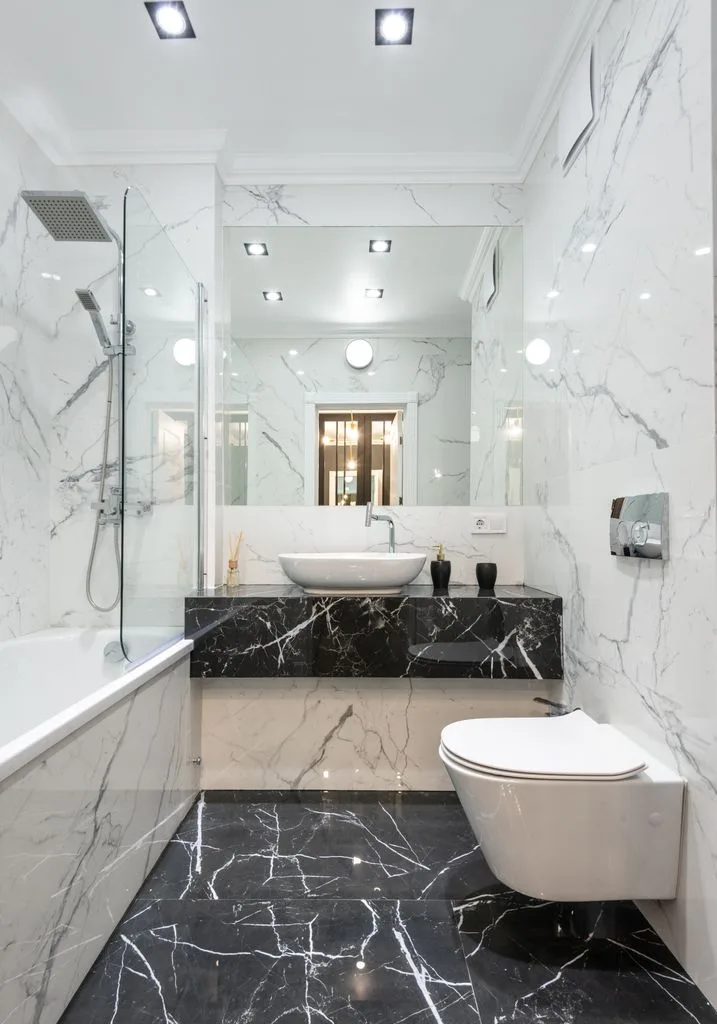
Marble black white bathroom elegance sits where high contrast meets classic luxury. White marble with soft gray veining has been the mark of a fine bathroom for centuries, from Roman baths to Paris hotels, while black marble brings the drama that keeps white marble from feeling plain. Together they create a room that photographs beautifully, suits every home from a city apartment to a country house, and never fights with the towels, bottles, and everyday clutter a real bathroom collects.
The trick is proportion. Too much black marble and the room feels small and heavy. Too much white marble and the room feels cold and clinical. Designers usually aim for a white led room with black as the accent, roughly two parts white to one part black, then repeat the black in at least three places so it feels deliberate: a counter, a floor border, and a mirror frame, for example. Browse the marble tile bathroom ideas on Houzz and you will see the same rhythm again and again: white walls, one strong black moment, and warm light to soften the edge.
Marble is a natural stone, so every slab is one of a kind. That is part of the charm and part of the work. Real marble needs sealing, gentle cleaners, and quick wipe ups when toothpaste or makeup lands on it. If that sounds like too much care, marble look porcelain gives you the same veined pattern with almost no upkeep, and it is the smart pick for a busy family bathroom or a rental. This guide covers both, and flags where the real stone is worth the effort and where the porcelain lookalike wins.
Key Takeaways
- Let white marble lead and black marble accent, roughly two parts white to one part black.
- Repeat black in at least three places so the contrast feels deliberate, not accidental.
- Seal real marble twice a year and use gentle, pH neutral cleaners only.
- Matte black fixtures tie white and black marble together better than chrome.
- Warm light, wood, and soft textiles keep a black and white marble bathroom from feeling cold.
- Marble look porcelain is the low maintenance choice for floors and shower walls.
1. White Marble Walls with Soft Gray Veining
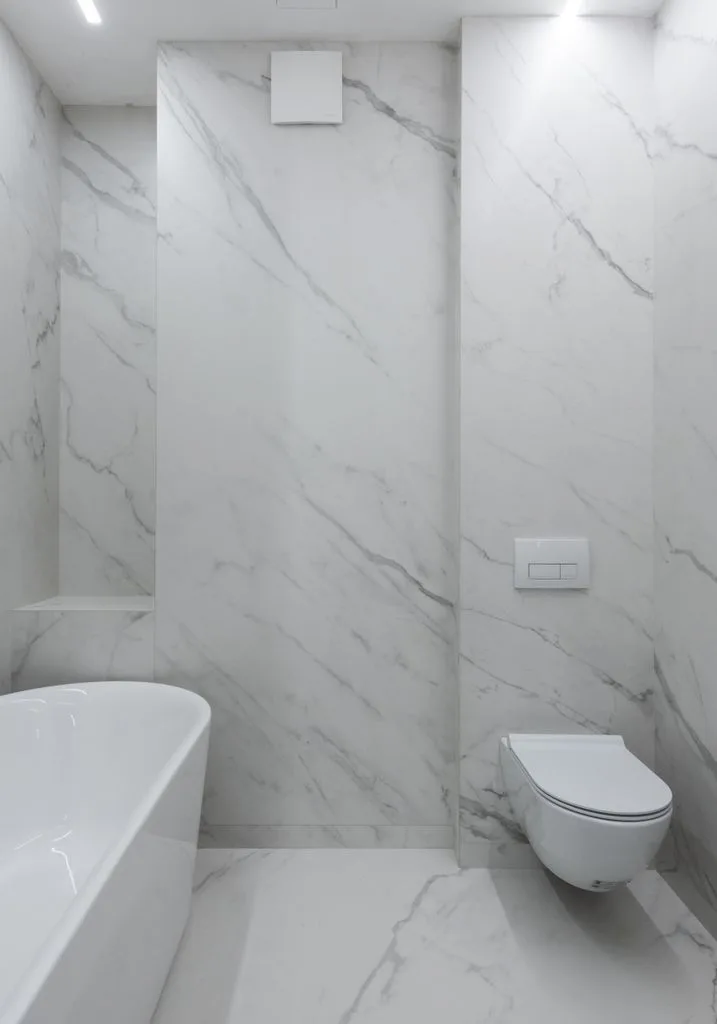
Start with the classic: white marble walls with soft gray veining, running from floor to ceiling behind the tub or vanity. Large format slabs or oversized tiles keep grout lines to a minimum, so the veining reads as one continuous piece of stone instead of a patchwork. Carrara marble is the budget friendly classic with fine gray veins, while Calacatta brings bolder, more dramatic veining for a stronger statement. Either one instantly makes a plain bathroom feel like a boutique hotel.
Keep everything else quiet so the stone can shine. White fixtures, a simple mirror, and one black accent such as a matte black faucet stop the room from feeling washed out. Seal the marble before first use and again every six months, and wipe up splashes of toothpaste, hair dye, and colored soaps right away, since real marble stains faster than most people expect.
2. A Black Marble Feature Wall

One wall of black marble does more for a bathroom than a whole room of black paint ever could. Nero Marquina marble, with its deep black base and fine white veins, turns the wall behind a vanity or a freestanding tub into a work of art. The white veining keeps the black from feeling flat, and it picks up the white marble elsewhere in the room so the two stones feel like a pair instead of a clash.
Place the feature wall where you see it first when you walk in, usually behind the vanity mirror or behind the tub. Light it well: a pair of sconces or a pendant on either side stops the dark stone from swallowing the light. Keep the rest of the room mostly white so the black wall reads as a deliberate focal point. A white vessel sink on a black marble counter in front of the wall doubles the drama without adding a second idea.
3. A Marble Floor in Bold Black and White
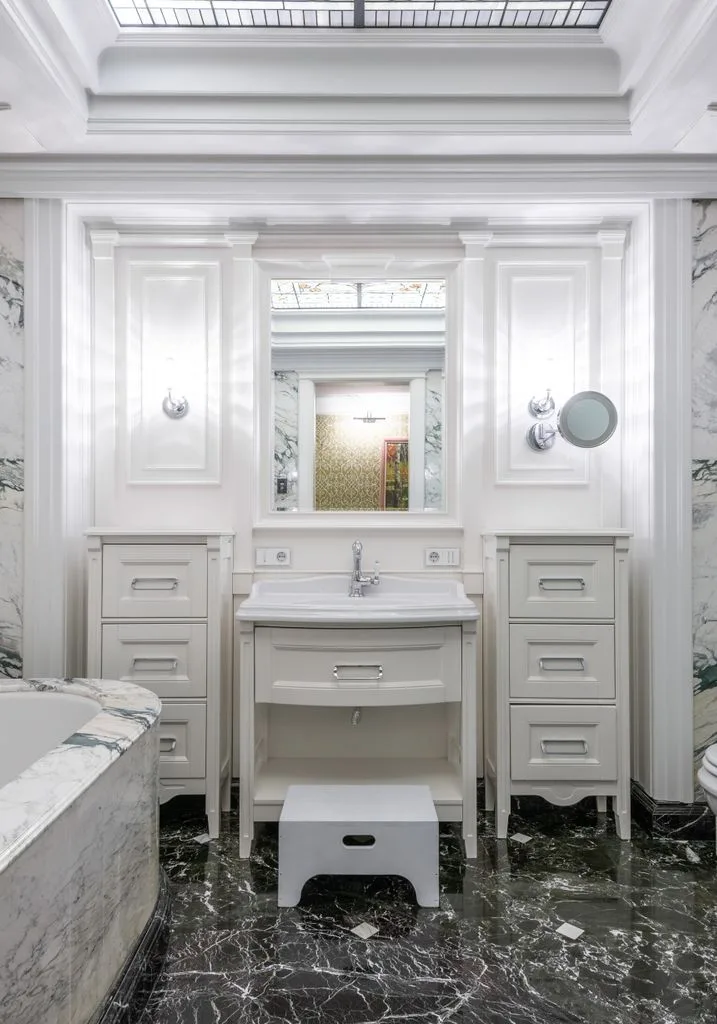
The floor is the easiest place to commit to black and white marble, because it grounds the whole room without touching the walls. A checkerboard of black and white marble tiles is the timeless choice, and it suits everything from a Victorian remodel to a modern loft. For a softer look, use large white marble tiles with a thin black marble border, or a black marble floor with white marble inlay around the tub.
Marble floors can be slippery when wet, so choose a honed finish instead of polished for the floor, and add a textured bath mat by the tub and shower. Honed marble also hides water spots and footprints better, which matters in a room you use barefoot every day.
📌 Related Articles:
4. A Freestanding Tub Set in Marble
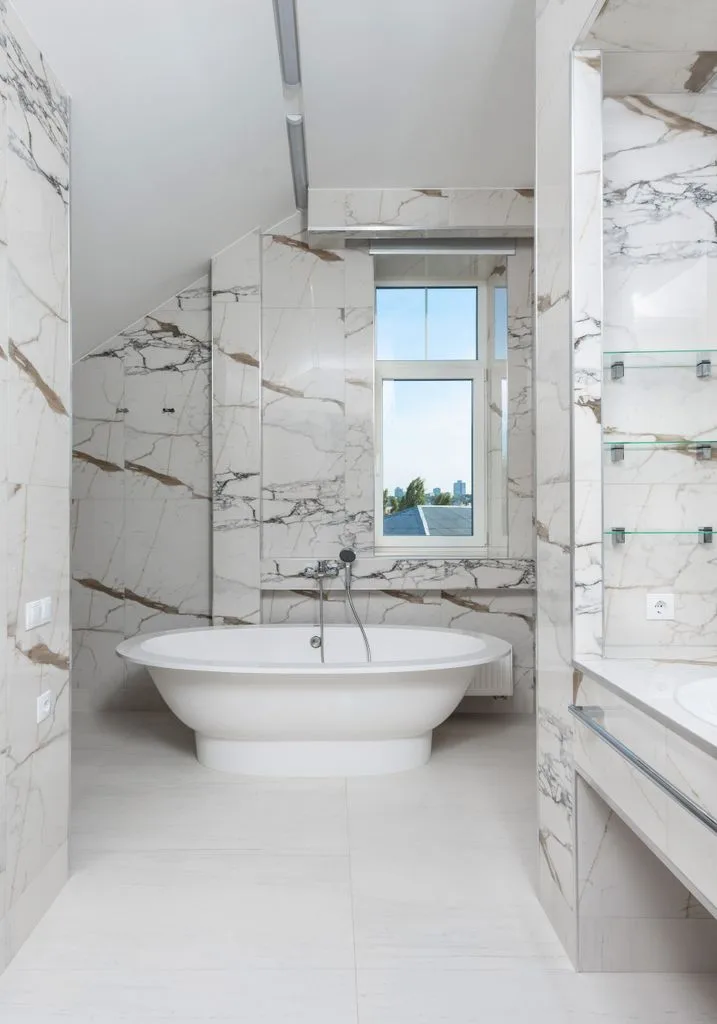
A freestanding tub is the centerpiece of an elegant marble bathroom, and the stone around it is what makes it feel finished instead of floating. Set the tub against a full marble wall, or on a raised marble platform with a few inches of stone visible at the base. The tub itself stays simple and white, so the marble does the talking. A tall window beside the tub, if you have one, turns bath time into the best seat in the house.
Leave at least 15 centimeters of clear space around the tub for cleaning, and choose a floor mounted or wall mounted tub filler in matte black to echo the dark marble in the room. A small marble side table or a teak bath tray holds a book and a candle without cluttering the edge of the tub. Keep the styling minimal here: one tray, one candle, one plant, and let the stone carry the room.
5. A Vessel Sink on a Black Marble Counter
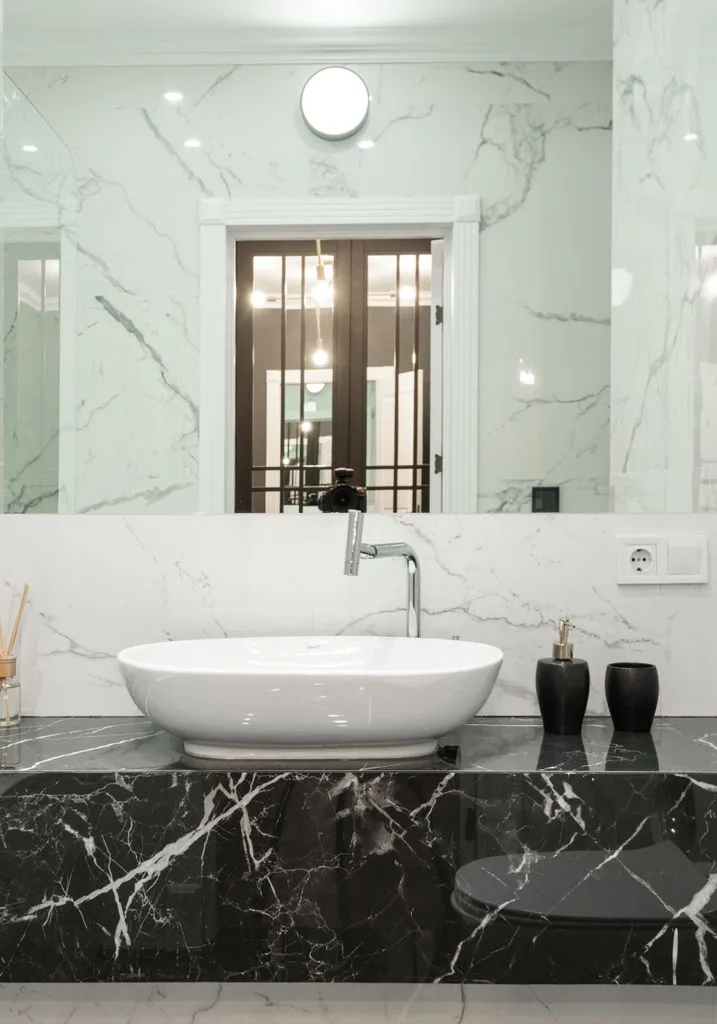
A white vessel sink sitting on a black marble counter is one of the most photogenic pairings in bathroom design. The white bowl pops against the dark stone, the black counter hides water spots and toothpaste marks, and the whole vanity looks custom even when it is not. Choose a counter with strong white veining so it connects visually with white marble walls or floors elsewhere in the room.
Keep the counter clear except for a soap dispenser and one small tray. A vessel sink sits higher than a standard sink, so check the height before you buy: the rim of the bowl should sit around 85 to 90 centimeters from the floor, which usually means a lower vanity cabinet underneath. Pair it with a tall matte black faucet, wall mounted if your plumbing allows, so the counter stays clean and open.
6. A Black Vanity Cabinet under White Marble
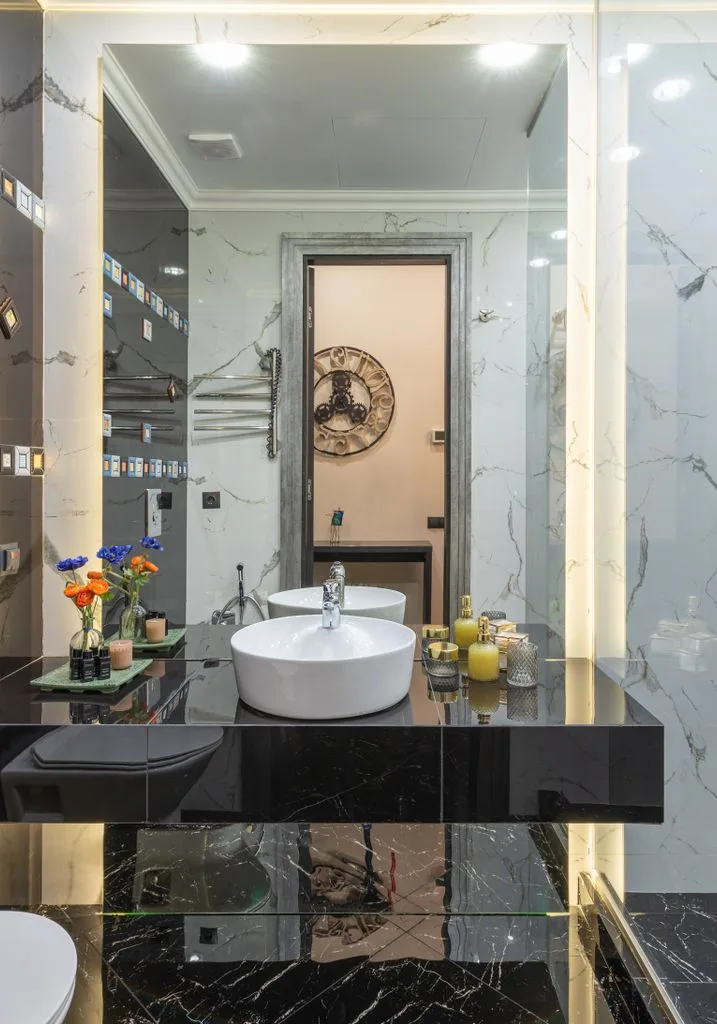
Flip the usual formula: put the black on the cabinet and the white marble on top. A black vanity cabinet with a thick white marble counter gives you the same high contrast as a black counter, but it is easier to live with, since white marble shows fewer water marks and the black cabinet hides scuffs from shoes and cleaning tools. Shaker style doors keep the look classic, while flat slab doors push it modern.
Choose a counter with an edge that suits the room: a simple eased edge for a clean modern look, or an ogee edge if the rest of the bathroom leans traditional. Add matte black pulls or knobs that match the faucet, and keep the cabinetry to one wall so the black does not overpower the room. Inside, drawers beat doors for a vanity, since they keep bottles and brushes visible and easy to reach.
7. A Glass Shower Framed in Marble
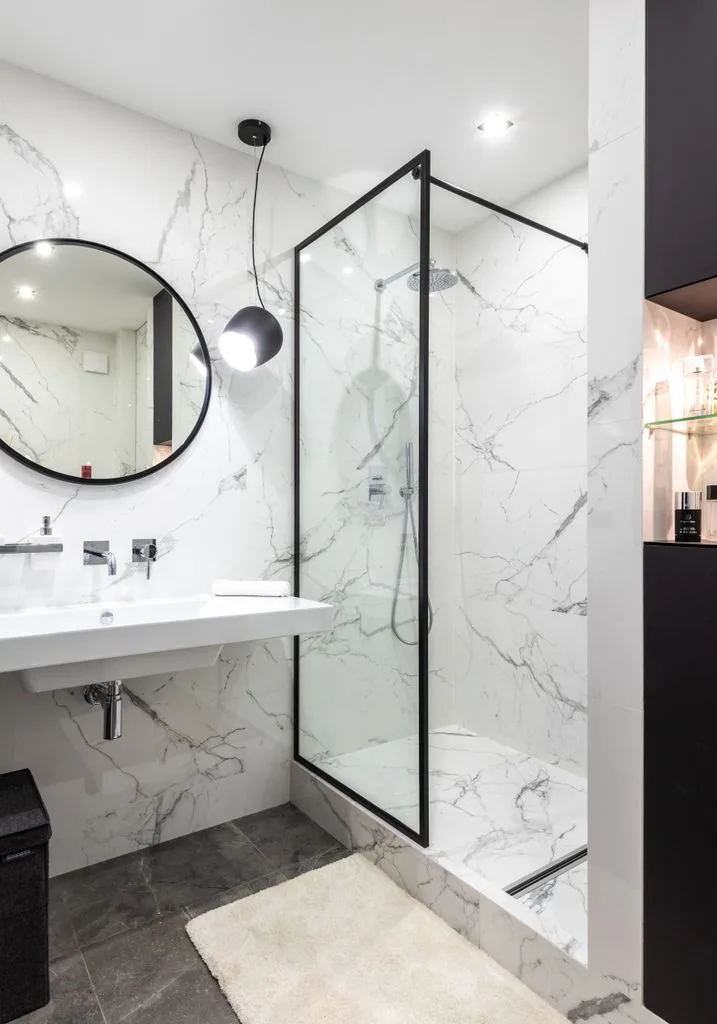
A glass shower with marble on every wall feels like a spa, and the glass is what makes it work in a small room. Frameless glass keeps the sight line open so the marble reads as one continuous surface, while the black marble threshold or the black framed door adds the contrast that stops white marble from looking plain. Carry the same marble from the shower walls onto the shower floor in a smaller mosaic size for grip.
Add a recessed niche lined in the same marble, with a black metal edge trim for a finished look. A niche beats a shower caddy every time: it keeps bottles off the floor, it never rusts, and it looks built in from day one. Place the niche at chest height on the wall opposite the shower head so bottles stay out of the direct spray and within easy reach.
8. A Marble Tub Surround with a Built In Shelf
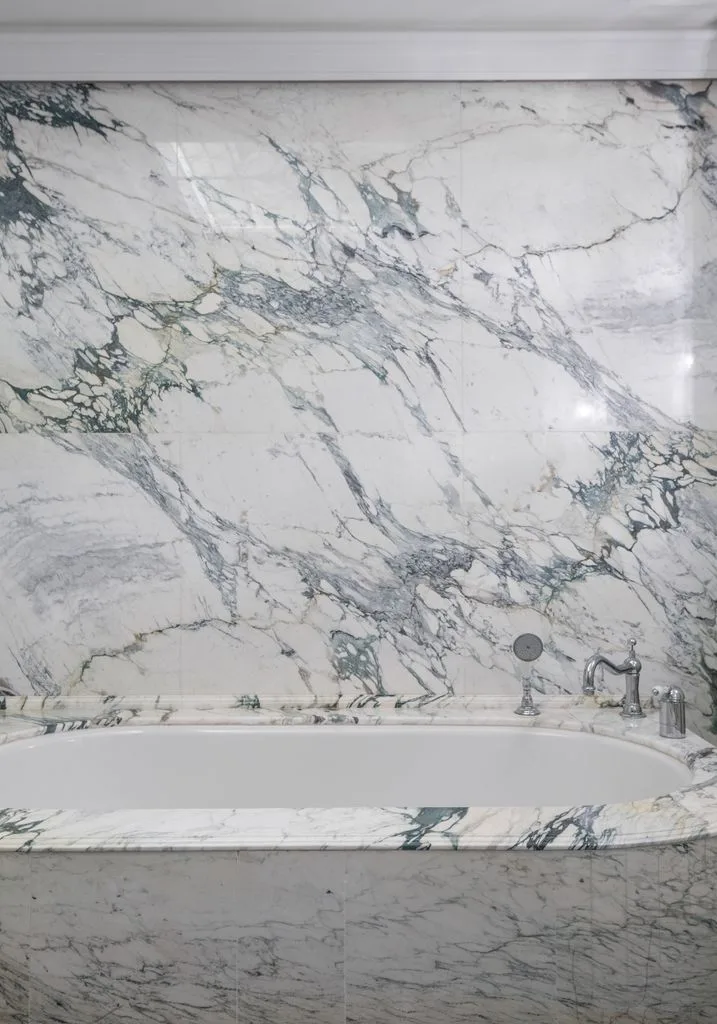
If a freestanding tub is not in the budget or the floor plan, a built in tub with a marble surround gives you the same stone moment for less money. Clad the whole surround in the same white marble as the walls, and add a wide ledge on one side that works as a shelf for candles, a book, and bath salts. The ledge turns the tub into a piece of furniture instead of a hole in the floor.
Match the grout to the marble, not the tile, so the joints disappear and the surround reads as solid stone. A light gray grout on white marble is the safe choice, and it ages better than bright white grout, which can yellow in a steamy room. Add a matte black tub filler and a black framed mirror above the tub wall, and the whole corner feels designed rather than assembled.
9. A Black Marble Vanity Wall with Pendant Lights
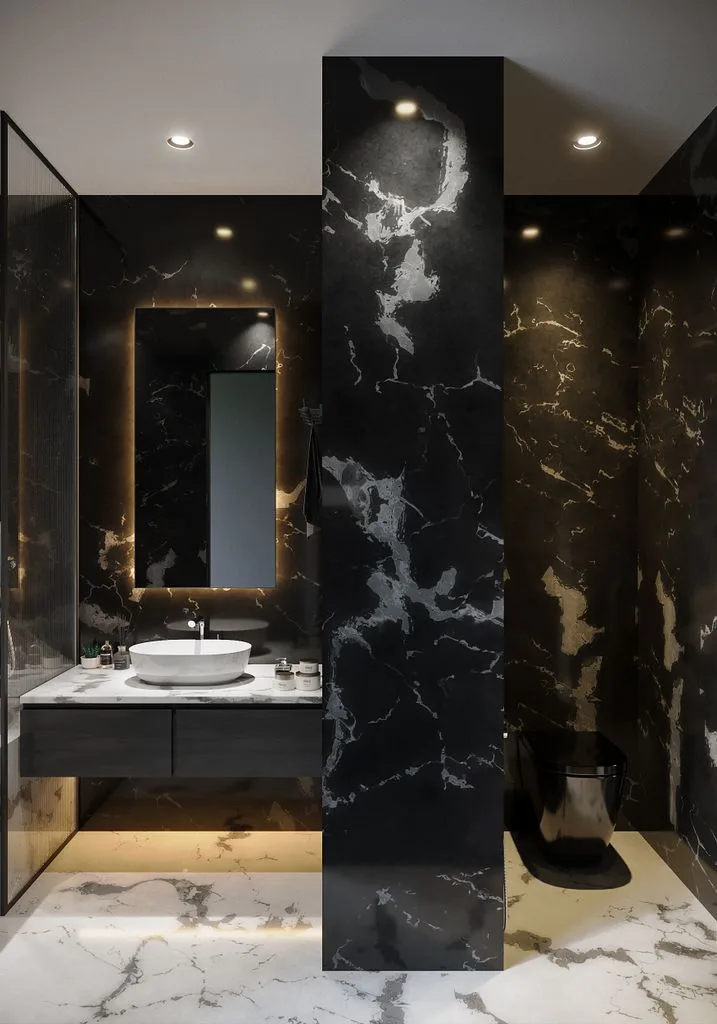
Take the black marble up the whole vanity wall, floor to ceiling, and hang a pair of pendant lights in front of it. The pendants do two jobs at once: they light your face evenly for the mirror, and their glow against the dark stone creates the warmest spot in the room. Round glass pendants or slim black metal pendants both work, as long as they hang at the same height and clear the top of the mirror by a few inches.
This is a strong look, so keep the rest of the vanity simple: a white vessel sink, one tray, and a clear counter. A tall black marble column or a full height slab on one side of the mirror adds architecture without adding clutter. If the budget is tight, use black marble look porcelain on the wall and save the real stone for the counter, since nobody can tell the difference from two steps away.
10. Marble Countertop Styling with a Tray
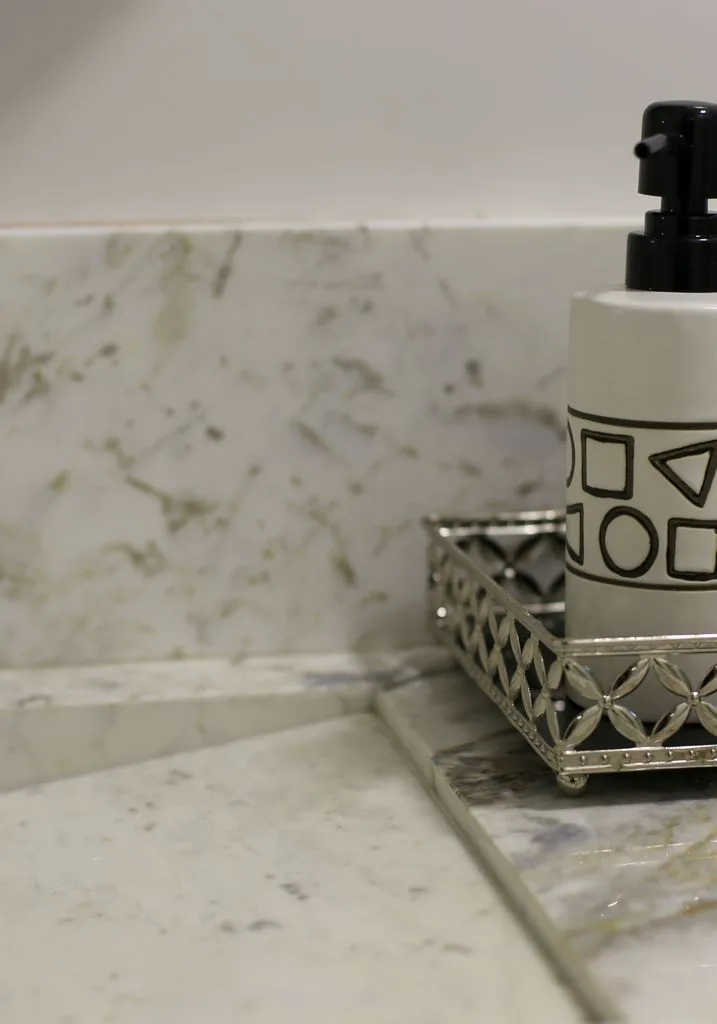
A marble countertop deserves styling that respects the stone, and a tray is the simplest way to do it. One tray corrals the soap dispenser, a small vase, and a candle into a single tidy group, and it protects the marble from rings and drips at the same time. Choose a tray in black metal, smoked glass, or dark wood so it reads against the white marble instead of disappearing into it.
Keep the tray to one third of the counter or less, and leave the rest clear for daily use. A black and white patterned soap dispenser or a small bud vase with one stem adds personality without clutter. This is also the easiest idea on the list to try today: a tray and a dispenser cost less than a dinner out, and they make an ordinary counter look like a styled photo.
11. A Double Vanity in Marble and Black
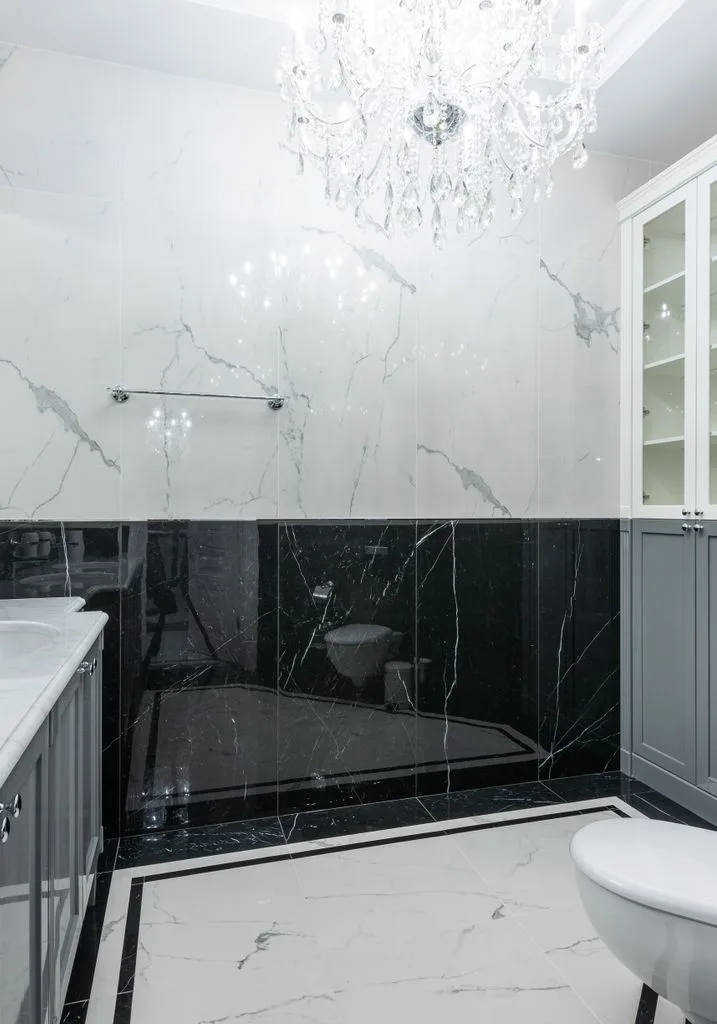
A shared bathroom works better with a double vanity, and marble makes the extra counter feel like a luxury instead of a compromise. Give each person a sink, a mirror, and a stretch of counter, then join the two sides with one continuous marble top so the vanity reads as a single piece of furniture. A black marble floor or a black vanity wall behind it keeps the long white counter from feeling like a hotel lobby.
Leave at least 75 centimeters of counter per person, and hang the mirrors with a small gap between them so each side feels like its own station. Two matching sconces or pendants, one per mirror, give even light for both people at once.
12. A Lit Marble Niche in a Black Wall
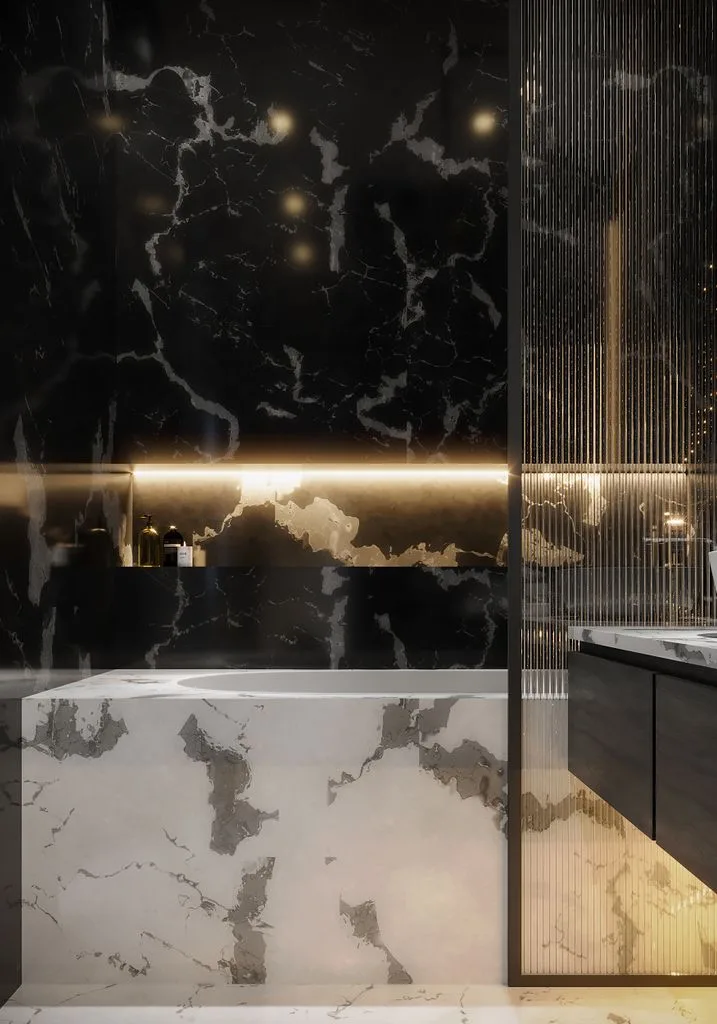
A niche cut into a black marble wall, lined in white marble and lit from above, is the kind of detail guests notice and remember. The light turns the niche into a small display case for a vase, a candle, or a sculptural bottle, and the white marble inside glows against the dark stone around it. It is a small move with an outsized effect, and it costs far less than a second slab of stone.
Plan the niche before the tile goes up, since cutting into a finished wall is messy and expensive. Keep it at least 30 centimeters wide and 40 centimeters tall so it holds real objects, not just decoration, and line the back in the same white marble as the rest of the room. A warm LED strip hidden under the top edge gives the glow without a visible fixture.
13. Marble Shower Walls with Black Columns
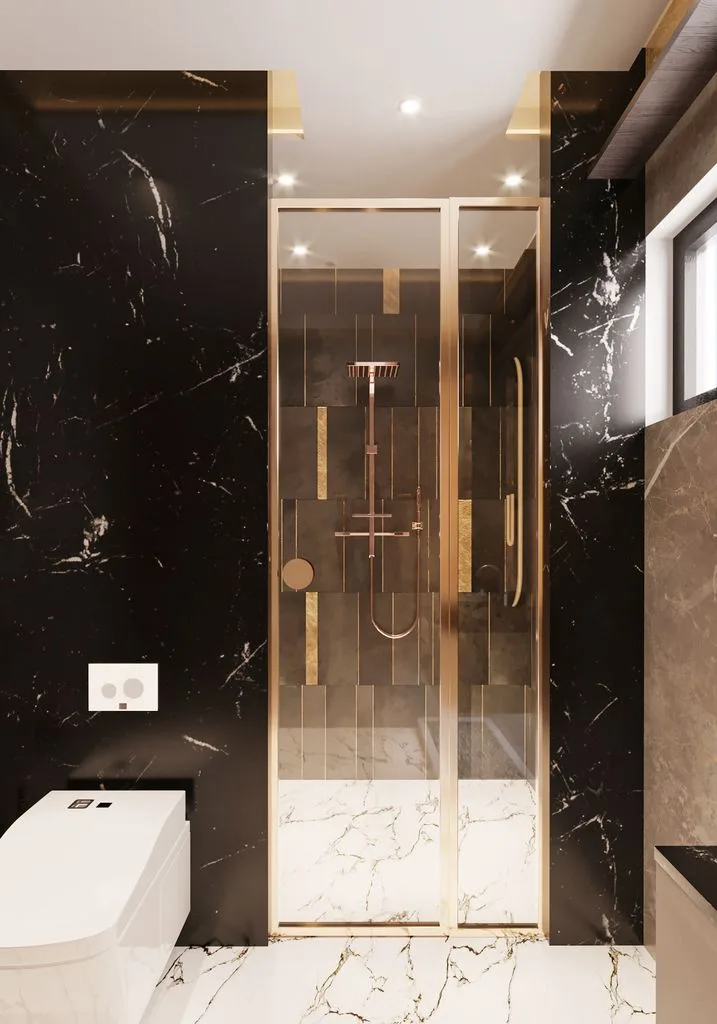
Gray and white marble shower walls with black marble columns at the corners look like a room from a grand hotel, and the idea scales down well to an ordinary home shower. The columns frame the shower like architecture, while the lighter marble between them keeps the space bright. Use large format tiles on the walls and a small marble mosaic on the floor for grip, and the whole shower reads as one calm, veined surface.
Carry the black into the shower in small doses: a black shower head, black controls, and a black framed glass panel. The fixtures will read as jewelry against the stone instead of clutter. Seal the grout as well as the stone, since shower grout sees more water than any other joint in the house, and a sealed joint stays bright years longer than an unsealed one.
14. A Mirror over a Marble Vanity
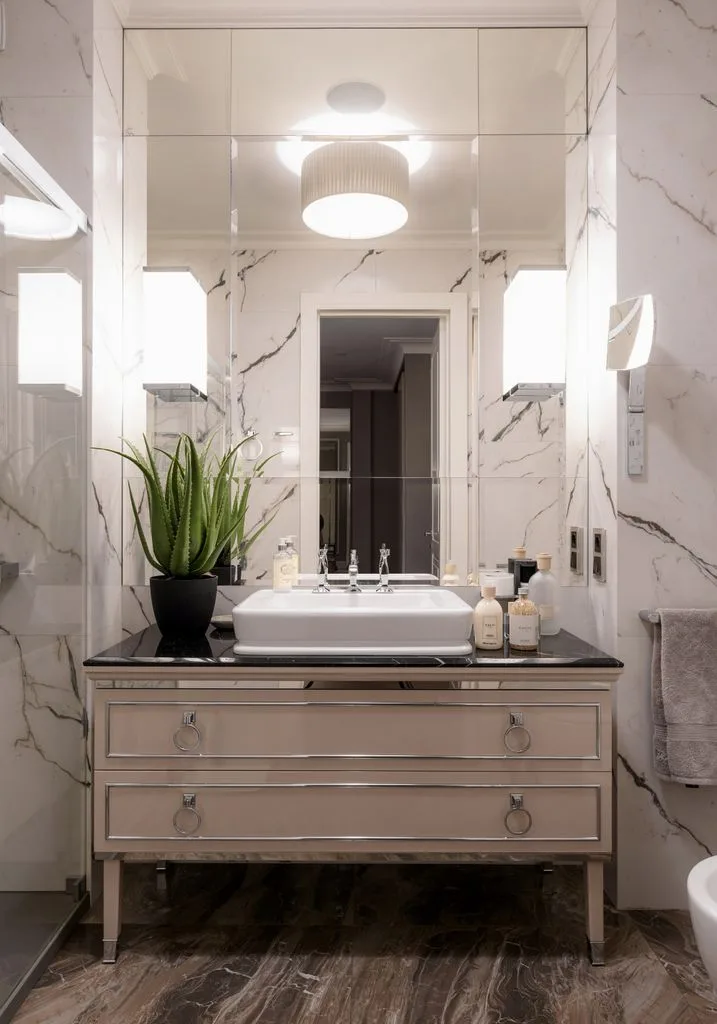
The mirror over a marble vanity is where the room doubles itself, so choose it with care. A large round mirror softens all the straight lines of the stone and tile, while a tall arched mirror adds height and a classic feel. A black frame ties the mirror to the black marble in the room, and a thin frame keeps the focus on the reflection instead of the hardware.
Hang the mirror so its center sits at eye level, roughly 150 to 160 centimeters from the floor, and leave a few inches between the bottom of the mirror and the top of the faucet so splashes do not spot the glass. A mirror with a built in light, or a pair of sconces on either side, gives the even, shadow free light that a single ceiling light never can. Keep the wall around the mirror clear so the reflection shows marble, not clutter.
15. Pendant Lights over a Marble Sink
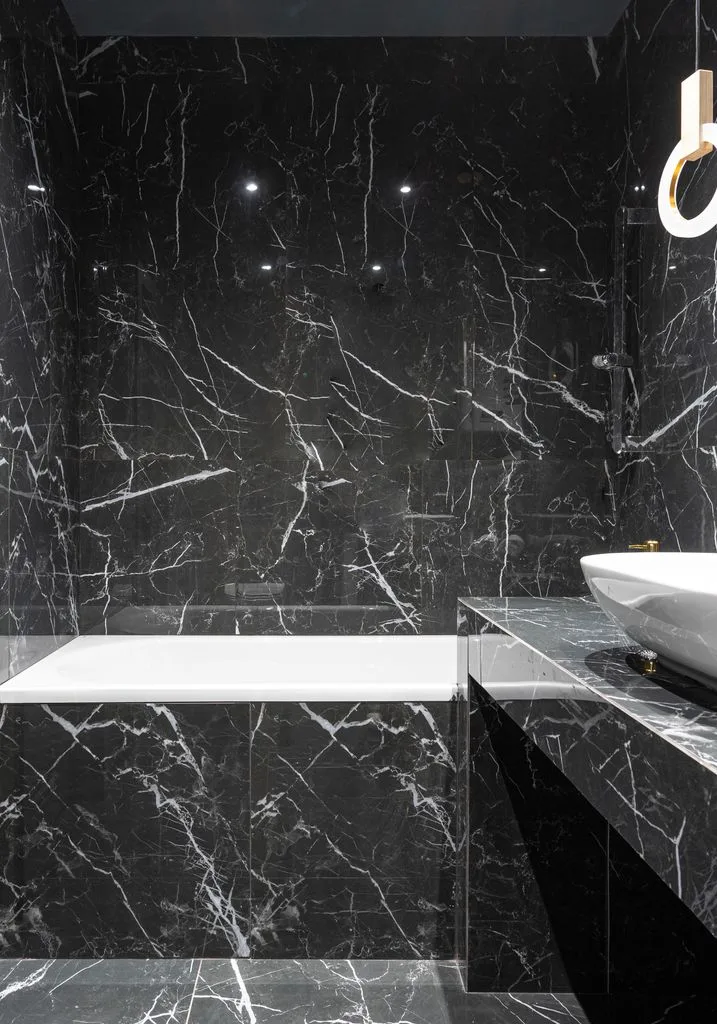
Pendant lights over a marble sink turn a functional corner into the prettiest spot in the bathroom. A pair of round glass pendants, hung at the same height on either side of the mirror, casts a warm glow across the stone and makes the veining look three dimensional. The light also flatters faces far better than a single overhead fixture, which is the whole point of a vanity light.
Hang the pendants so the bottom of the shade sits around 190 centimeters from the floor, clear of the mirror but low enough to light your face. Choose warm white bulbs, around 2700 Kelvin, so the marble looks creamy instead of blue. Black metal pendants echo black marble elsewhere in the room, while clear glass pendants disappear and let the stone take the stage.
16. Marble in a Small Bathroom
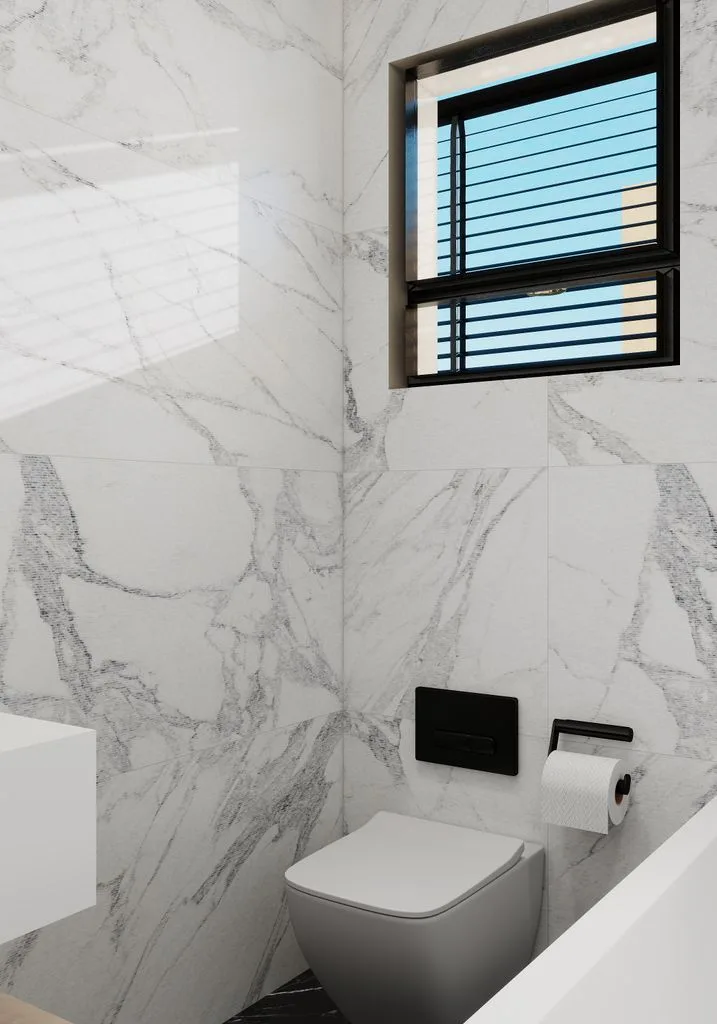
Small bathrooms benefit from marble more than large ones do, because the stone makes a tight room feel considered instead of cramped. Use white marble on the walls and floor, keep the black to one or two accents such as a black framed window or a black storage niche, and let the mirror do the rest. A large mirror over the sink, or a mirrored wall beside the tub, doubles the light and the sense of space.
Choose large tiles in a small room, not small ones: fewer grout lines make the walls read as bigger, calmer surfaces. A wall hung vanity and a wall hung toilet free up floor space and show more of the marble floor, which makes the room feel larger underfoot. Keep the styling to one tray and one plant, since a small room with too many objects feels busy no matter how pretty the stone is.
17. A Soaking Tub on a Black Marble Floor
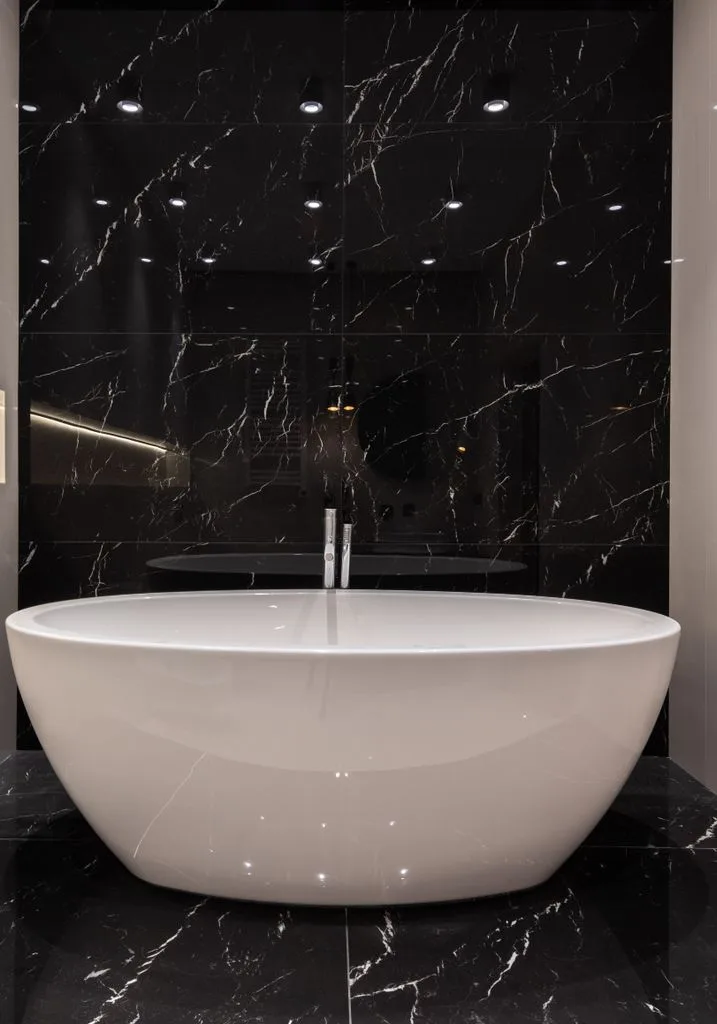
Set a white soaking tub directly on a black marble floor and the contrast does all the work. The white tub glows against the dark stone, the floor hides splashes and dust, and the whole corner looks like a photograph even with nothing else in it. A black marble feature wall behind the tub completes the frame, while white walls on the other sides keep the room from feeling dark.
Choose a tub with a simple oval shape and no feet, so it sits cleanly on the stone and reads as modern. A floor mounted matte black filler beside the tub echoes the floor without competing with it. Add one soft layer, such as a folded white towel on the tub edge or a small wooden stool nearby, so the black and white palette has something warm to land on.
18. A Styled Marble Vanity with Fresh Flowers
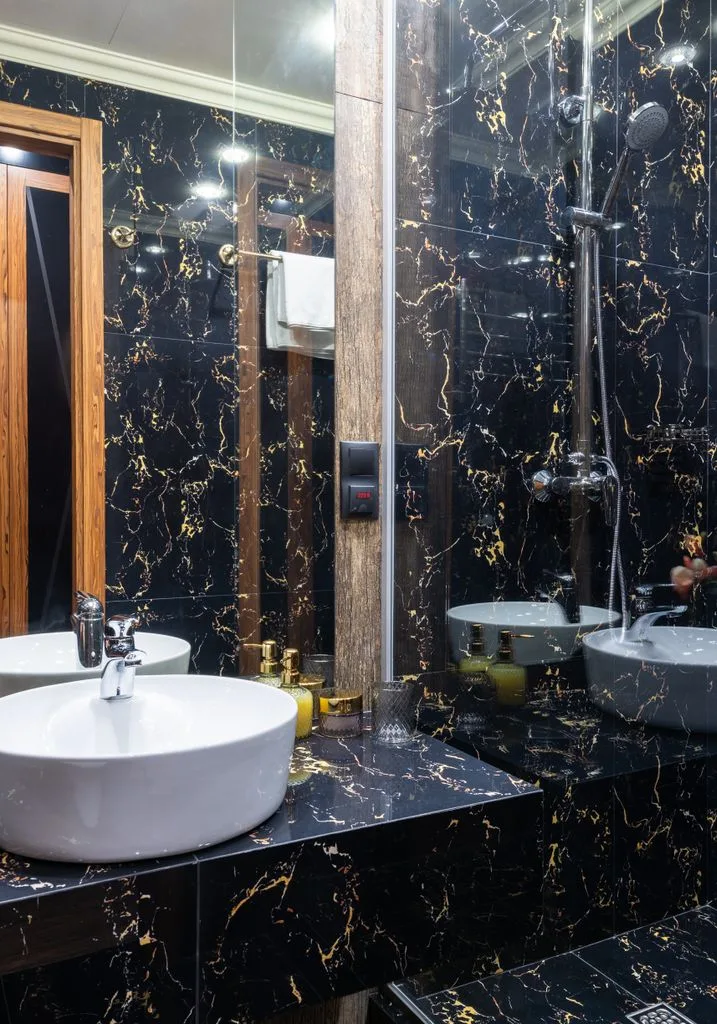
Fresh flowers are the cheapest way to make a marble bathroom feel alive, and they look especially good against black marble. A small vase of pink or white blooms on a black marble counter adds the one soft, living note the stone cannot provide on its own. Eucalyptus, roses, or a single orchid stem all work, and they last a week or more in a steamy bathroom.
Keep the rest of the vanity edited so the flowers have room to shine: two vessel sinks, matching faucets, and one tray per sink at most. A wooden framed mirror or a warm wood stool softens the black stone the same way the flowers do, and the combination of stone, wood, and fresh stems is what separates an elegant bathroom from a cold showroom. Swap the flowers weekly and the room never feels finished in a stale way.
19. Marble with Warm Wood Accents
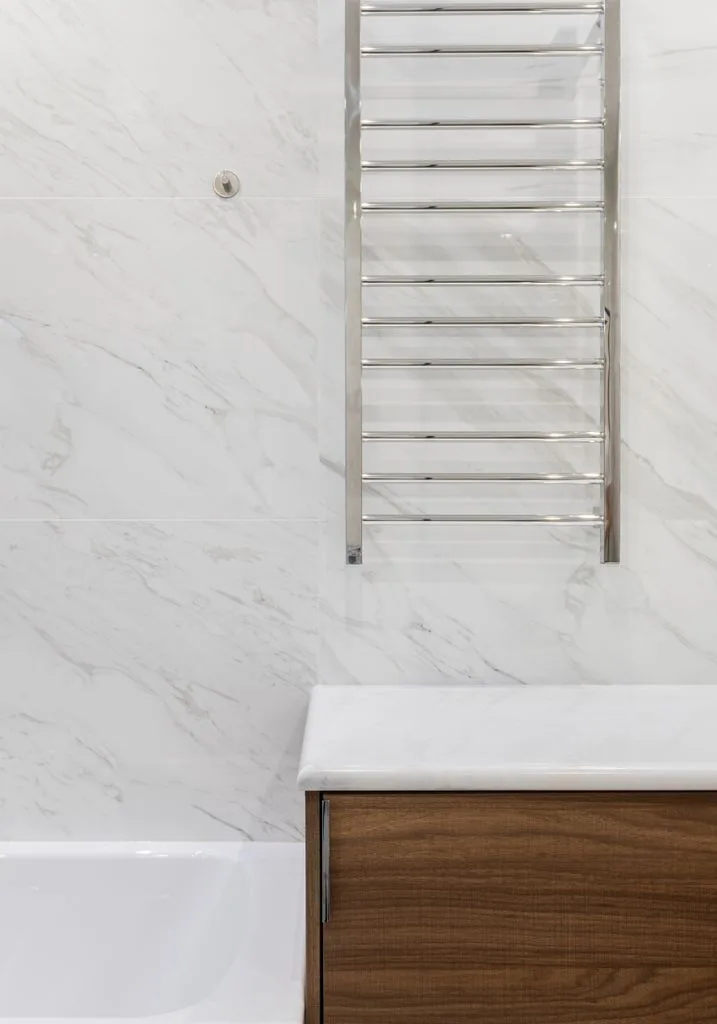
Marble and wood are natural partners, and a little warm wood is the fastest way to keep a black and white marble bathroom from feeling cold. A wooden vanity under a white marble top, a teak bath tray, or a warm wood stool beside the tub adds the honey tones that stone cannot provide. The wood does not need to be everywhere: one or two pieces are enough to warm the whole room.
Choose wood with a clear finish and a medium tone, such as white oak or walnut, and keep it away from direct water so it ages well. A wooden vanity with a white marble top and matte black hardware ties all three materials together in one piece of furniture, and it is the single best investment on this list if you can only pick one change. Add a woven basket for towels and a small green plant, and the room feels finished, lived in, and warm.
How to Choose the Right Marble for Your Bathroom
Start with the room, not the stone. A small bathroom with little natural light wants white marble with soft veining, since it reflects light and opens the space up. A large bathroom with a big window can carry a black marble feature wall or a black marble floor without feeling heavy. North facing rooms run cool, so choose marble with warm gray or beige veining; south facing rooms can take the crisp white and gray stones without feeling cold.
Next, choose the finish. Polished marble shines and shows veining at its best, so it suits walls, counters, and tub surrounds. Honed marble has a soft matte surface that hides water spots and gives grip, so it suits floors and shower floors. Ask the supplier for a sample tile and live with it for a week: spill coffee on it, leave a wet glass on it, and see how it cleans. The stone you love on day one is the stone you will live with for a decade, so the sample test is worth the wait. For more real world inspiration, see how Apartment Therapy black and white bathroom makeover proves that a small budget and a strong black and white palette can transform an ordinary bath.
Finally, decide between real marble and marble look porcelain. Real marble is one of a kind, it can be refinished if it etches, and it adds value to a home, but it needs sealing and gentle care. Porcelain is nearly indestructible, needs no sealing, and costs less installed, but it cannot be refinished and the pattern repeats across tiles. Use real marble where you touch it every day, such as the vanity top, and porcelain where water and feet do the damage, such as the shower floor. That split gives you the beauty of stone where it matters and the durability of porcelain where it counts.
Marble Black White Bathroom Elegance on a Budget
You do not need a full remodel to get the marble black and white look. Start with the changes that cost the least and show the most: matte black hardware on the vanity and doors, a black framed mirror, black and white towels, and a marble tray on the counter.
At the middle of the range, replace the vanity top with a white marble remnant, which stone yards sell at a steep discount because it is left over from a larger job. A remnant is often large enough for a single vanity, and the installer cuts and polishes it in a day. Add a marble look porcelain floor or a black and white marble mosaic backsplash behind the vanity, and the room reads as a full renovation for a fraction of the price.
A full marble bathroom, with stone walls, floor, and counters, usually runs from 8,000 to 25,000 dollars depending on the size of the room and the stone you choose. Save money by using marble look porcelain on the walls and floor, real marble only on the counter, and a standard white tub instead of a freestanding one. Spend the savings on the two things you touch every day: a good faucet and good lighting. Both last longer than the stone and both change how the room feels every single morning.
Common Mistakes to Avoid
The most common mistake is using too much black marble. A room that is half black stone feels smaller and darker than it is, and it shows every water spot and dust mote. Keep black marble to one wall, one counter, or one floor, and let white marble carry the rest. If the room already feels dark, swap a black marble floor for a white marble floor with a black border and the whole space lifts.
The second mistake is skipping the sealer. Real marble is porous, and an unsealed counter stains the first time toothpaste, makeup, or hair dye sits on it for an hour. Seal every marble surface before first use, reseal twice a year, and keep a bottle of pH neutral stone cleaner under the sink. Vinegar, lemon, and bleach based cleaners etch marble on contact, so read the label before you spray anything near the stone.
The third mistake is mixing too many marble patterns. Two marbles can work together when one is quiet and one is bold, but three competing vein patterns turn the room into visual noise. Pick one hero marble for the walls or floor, one supporting marble for the counter, and keep everything else plain. The same rule applies to metals: pick matte black as your one metal and repeat it on the faucet, the hardware, and the mirror frame.
📌 Also Read:
Frequently Asked Questions
Is black and white marble too cold for a bathroom
It can feel cold if the room has no warm layers, but the fix is easy. Add warm light at 2700 Kelvin, one piece of warm wood such as a vanity or a stool, and soft textiles in white or cream. A rug by the tub, folded towels, and a plant do more to warm the room than any color change.
How do I keep white marble looking bright
Seal it twice a year, wipe up splashes right away, and clean it only with a pH neutral stone cleaner and a soft cloth. Avoid vinegar, lemon juice, and abrasive sponges, all of which etch or dull the surface. A quick daily wipe after the morning routine takes thirty seconds and keeps the stone looking new for years.
Can I use real marble on a bathroom floor
Yes, and it looks wonderful, but choose a honed finish for grip and seal it well. Honed marble hides water spots and gives your feet traction when the floor is wet. In a shower, use a small marble mosaic on the floor for extra grip, and keep the large polished tiles for the walls where nobody walks.
Is marble look porcelain a good substitute
For floors, shower walls, and busy family bathrooms, yes. Modern marble look porcelain copies the veining of real stone closely, needs no sealing, and resists stains and scratches far better than marble. Use real marble on the vanity top where you see and touch it up close, and porcelain everywhere water and feet do the damage.
What fixtures work best with black and white marble
Matte black fixtures are the natural match, since they repeat the black marble and disappear against it in the best way. A matte black faucet, shower set, and cabinet pulls tie the whole room together with one consistent metal. Avoid mixing chrome and black in the same room, since the two metals fight each other and break the calm the marble creates.
Conclusion
Marble black white bathroom elegance comes down to one idea: let the stone do the talking and keep everything else simple. White marble opens the room, black marble gives it drama, matte black fixtures tie the two together, and a little wood, warm light, and fresh flowers keep it feeling like a home instead of a showroom.
Pin this guide to your bathroom board on Pinterest so you can find it when you are ready to start, and save the photos you love most to a separate board for your remodel. Your future bathroom, calm, bright, and timeless, is one good decision away.


