
Top 17 Monochrome Black White Bathroom Ideas for a Timeless Look
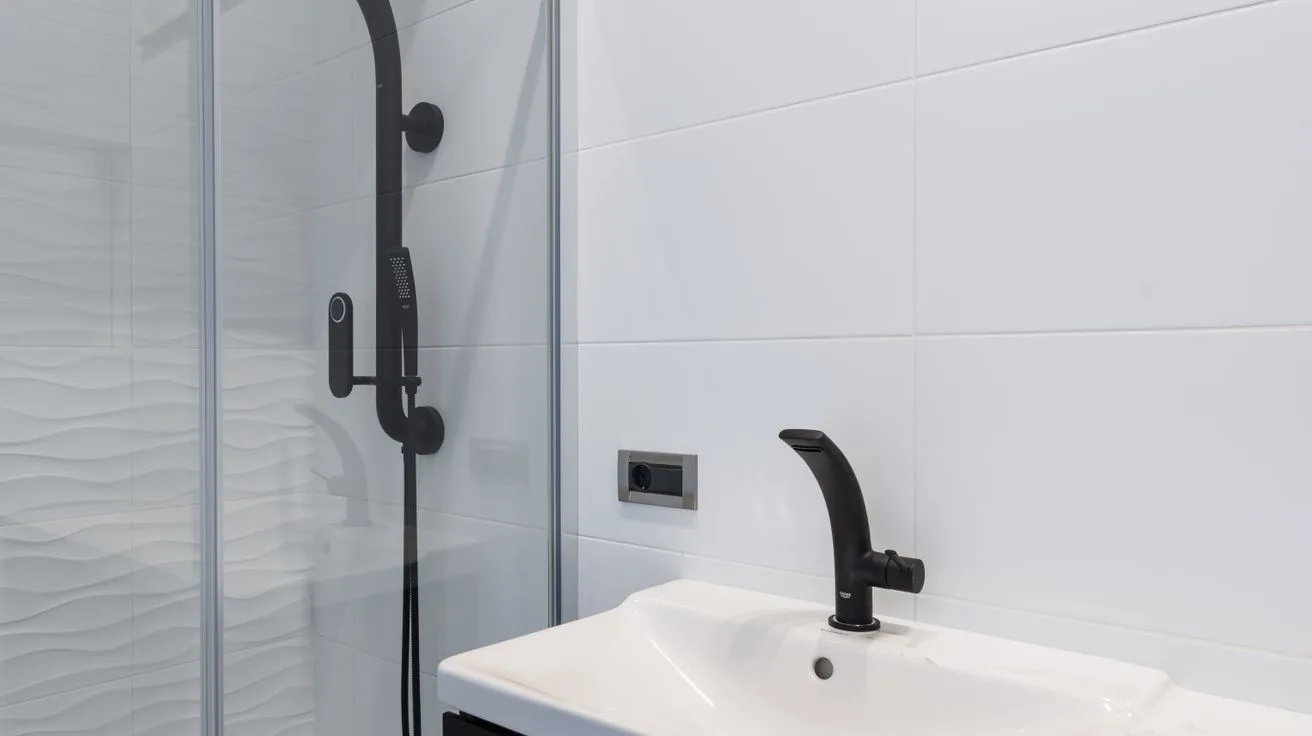
Black and white is the oldest trick in bathroom design, and it has never gone out of style. A monochrome black white bathroom feels crisp in the morning, calm at night, and expensive at every budget — because two colors, used with confidence, always look more intentional than five colors used timidly. It photographs beautifully, suits every home from a city apartment to a country cottage, and never fights with the towels, bottles, and everyday clutter a real bathroom collects.
In this guide you will find 17 monochrome black white bathroom ideas you can mix, match, and layer, from a full checkerboard floor to one black-framed mirror that changes the whole room. Every idea includes the materials to look for, realistic price ranges, and the styling moves that keep the look timeless instead of stark. You will finish knowing exactly where to put the black, where to keep the white, and what to skip.
Save this list before your next bathroom refresh. Most of these ideas work in a weekend — paint, hardware, textiles, and styling — and they build on each other, so start with one statement change and let the rest follow.
Overview
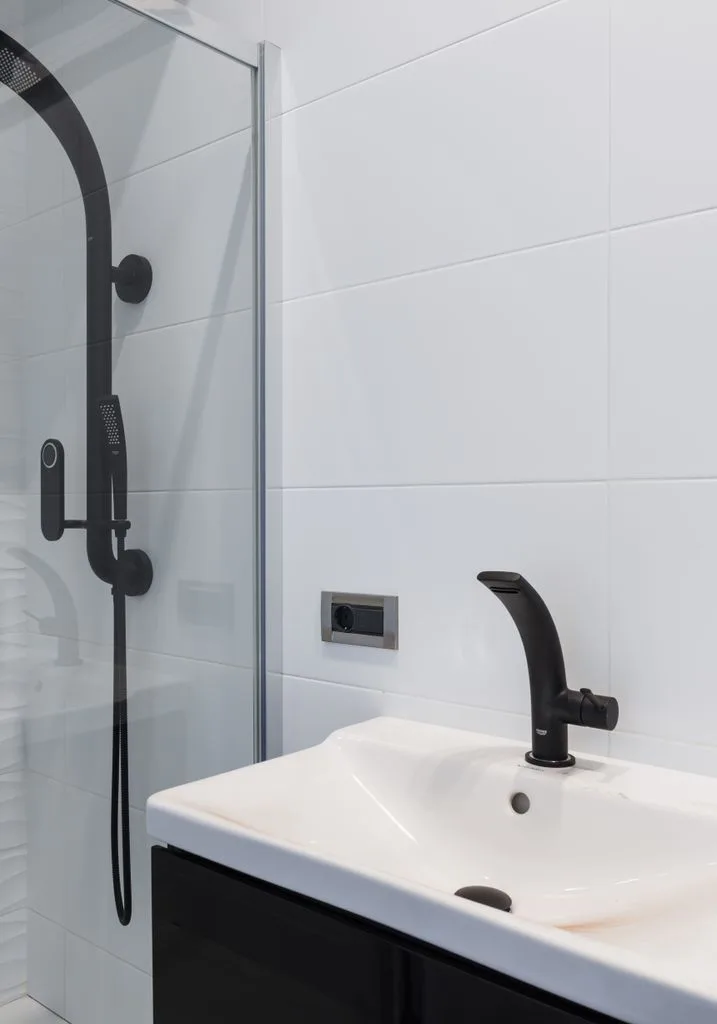
A monochrome black white bathroom sits where high contrast meets calm, classic design. Unlike a themed bathroom that dates quickly, black and white has survived every trend cycle since the 1920s: checkerboard floors in grand hotels, subway tile in city apartments, black-framed showers in modern lofts. The palette does the decorating, so the fixtures and finishes can stay simple — flat-front vanities, plain white sanitaryware, one warm wood or brass accent to keep the room from feeling cold.
The good news is that black and white is one of the most forgiving schemes to live with. White surfaces bounce light around small, windowless bathrooms, black hides water spots and scuffs better than any mid-tone, and the two colors together make even budget materials look deliberate. Work in one clear black statement plus a few small echoes, keep the white dominant so the room stays bright, and let texture and light do the rest.
Key Takeaways
- Let white dominate: roughly two-thirds white to one-third black keeps a monochrome bathroom bright and spacious instead of cave-like.
- One black statement first: a checkerboard floor, a black vanity, or a black accent wall — then echo the black in small doses so the room feels intentional.
- Matte beats glossy: matte black fixtures and soft-matte tiles keep the contrast calm and modern instead of harsh and shiny.
- Texture replaces color: marble veining, ribbed glass, woven baskets, and patterned tile add depth while the palette stays strictly black and white.
- Warmth is the secret ingredient: one warm wood tone or a single green plant stops a monochrome bathroom from feeling cold or clinical.
- Test black paint in your light: black shifts with daylight, so paint large swatches and live with them for a full day before committing.
1. Classic Checkerboard Floors
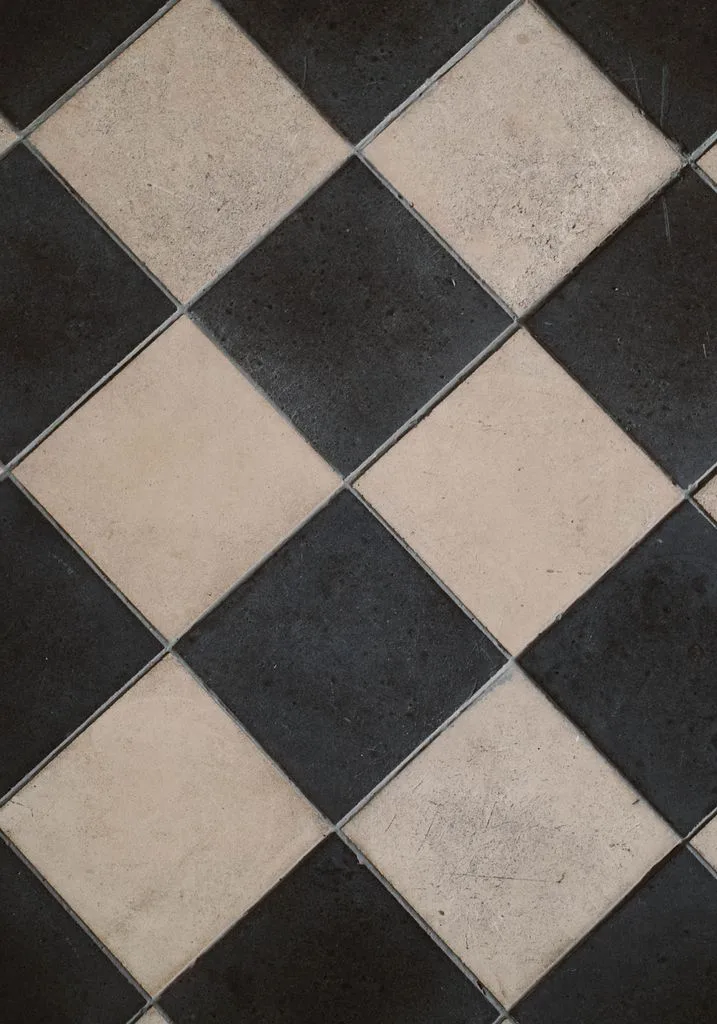
A checkerboard floor is the single most recognizable move in a monochrome black white bathroom, and it has earned that status: the pattern is bold enough to carry the whole room, yet classic enough to look right in a 1920s house or a brand-new flat. Large 12-inch squares feel grand and graphic in a master bathroom, while small 2-inch or penny checkerboard suits a powder room or a vintage-style bath. Porcelain checkerboard tile runs $4–$12 per square foot, and a small bathroom floor typically costs $600–$1,800 installed.
Keep everything else in the room quiet when the floor is this loud: plain white walls, a simple vanity, and minimal pattern elsewhere. The floor becomes the art, and the rest of the room frames it. If a full checkerboard floor feels like a lot, use the pattern in a small zone — the entry to the bathroom, or a rug-sized rectangle in front of the vanity — and plain white or large-format tile everywhere else. Seal grout lines well, because bathroom floors meet everything from hair dye to bath oil.
2. Black Vanity with a White Countertop
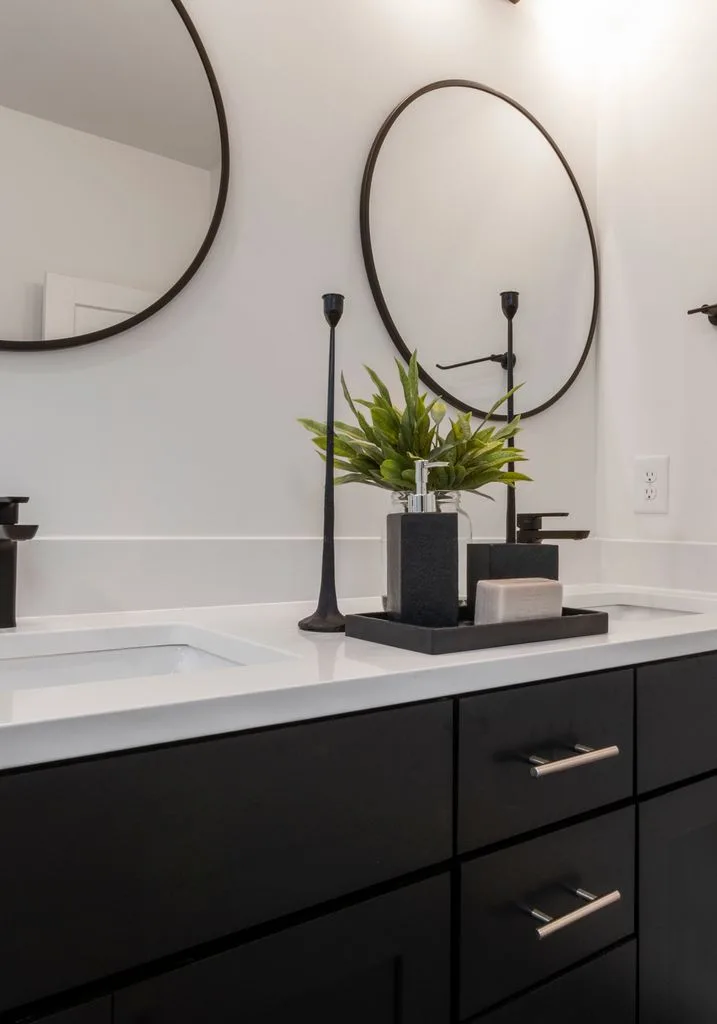
A black vanity under a white countertop is the workhorse of the monochrome bathroom: it grounds the room, hides splashes and scuffs, and gives the eye a firm dark anchor at the room’s center. Choose a flat-front or shaker-style vanity in matte black — the modern profile that lets the contrast be the star — with a crisp white quartz or solid-surface top. A quality 36-inch black vanity runs $500–$1,500, and a white quartz top adds $300–$700 depending on size and edge detail.
Pair it with matte black faucets and slim black hardware so the dark reads as one deliberate block rather than scattered bits. A white vessel sink on top adds a second layer of contrast and turns the vanity into the room’s photo moment. If a full black vanity feels heavy in a small bathroom, try a floating black vanity instead: the wall-hung design shows more floor, which makes the room feel bigger while keeping the same bold contrast.
3. White Subway Tile with Black Grout
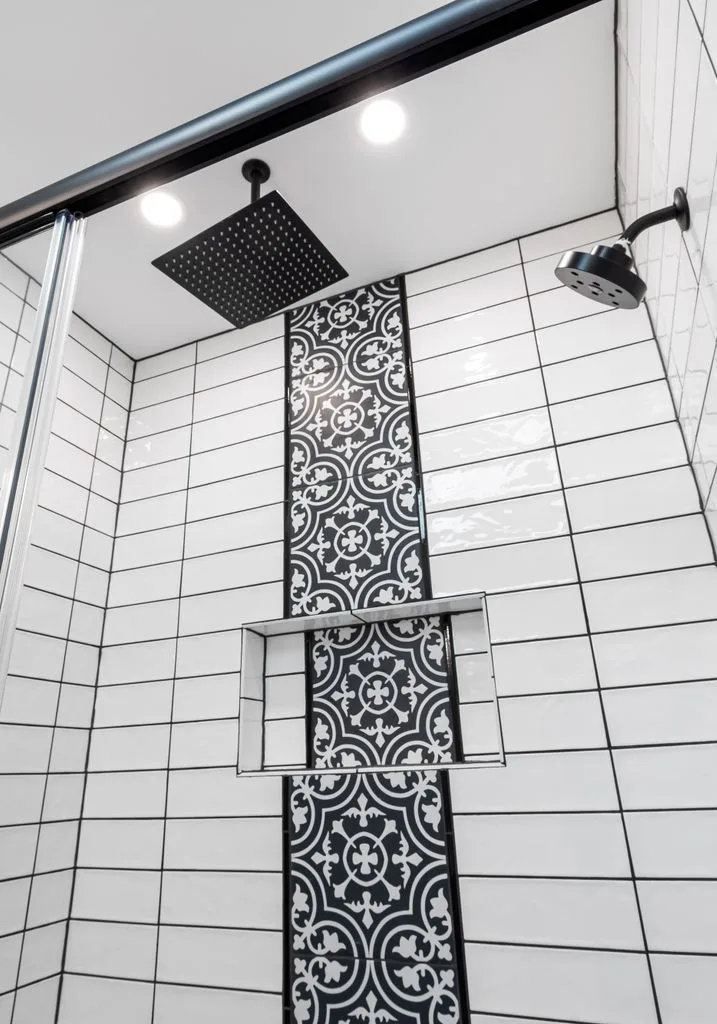
White subway tile with black grout is the easiest high-contrast move in any bathroom, and it costs little more than standard tiling. The dark grout lines turn plain white tile into a graphic grid, outline every tile like a drawing, and — as a bonus — never show the grime that makes white grout look tired within a year. A standard 3-by-6-inch white subway tile costs $3–$8 per square foot, and charcoal or black grout adds almost nothing to the material bill.
Use it on one feature wall, in the shower, or as a full backsplash behind the vanity. Keep the grout lines neat and consistent — 1/8-inch joints look sharp and modern, while wider joints feel more handmade and vintage. Seal the grout after installation, because dark grout can stain light tile during application if it is not wiped carefully. For a softer version, try dark gray grout instead of pure black; you keep the graphic lines with a gentler contrast.
📌 Related Articles:
4. Freestanding White Tub Against a Black Wall
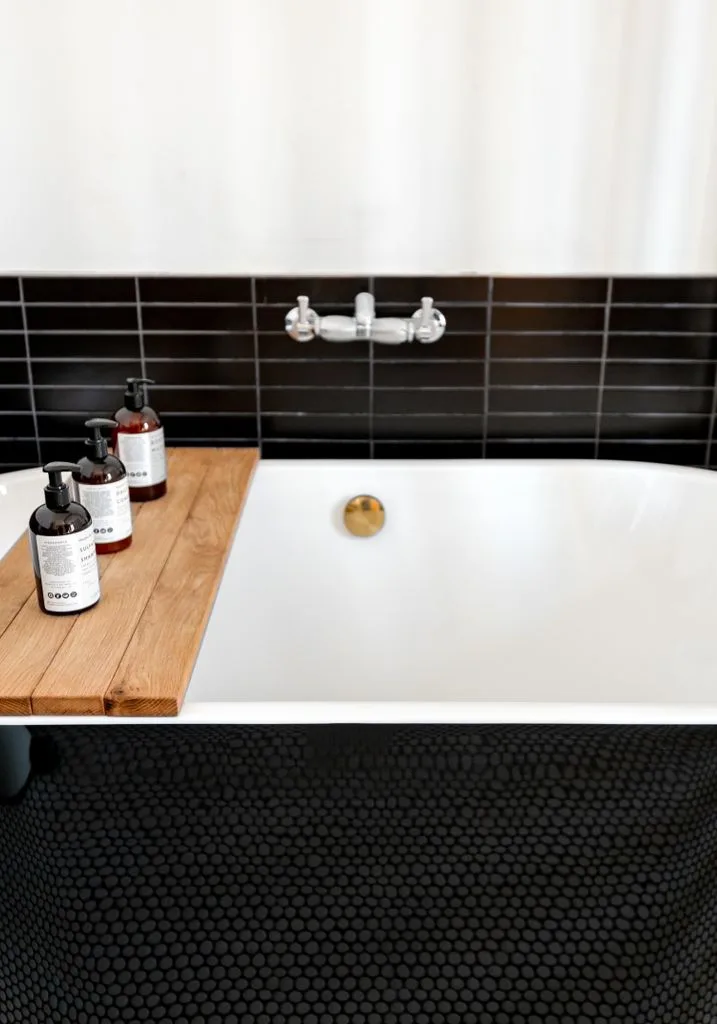
Nothing photographs like a white freestanding tub set against a black wall. The tub’s curves glow against the dark background, the contrast makes both elements look more sculptural, and the whole corner becomes the bathroom’s centerpiece without a single extra decoration. Paint the wall in a matte or eggshell black — matte hides imperfections better in a steamy room — and choose a simple oval or rectangular tub in glossy white. A freestanding acrylic tub runs $800–$2,500, and a gallon of quality black bathroom paint costs $35–$60.
Style the corner simply: a wooden bath tray across the tub, a folded white towel, and one small plant on the floor. The black wall does the drama, so the styling can stay quiet. Keep the rest of the room light — white floor, white ceiling, pale towels — so the dark wall reads as one bold backdrop rather than the start of a cave. In a rental, a freestanding black room divider or a large black-framed mirror behind the tub gives you the same silhouette with zero paint.
5. Black-Framed Glass Shower
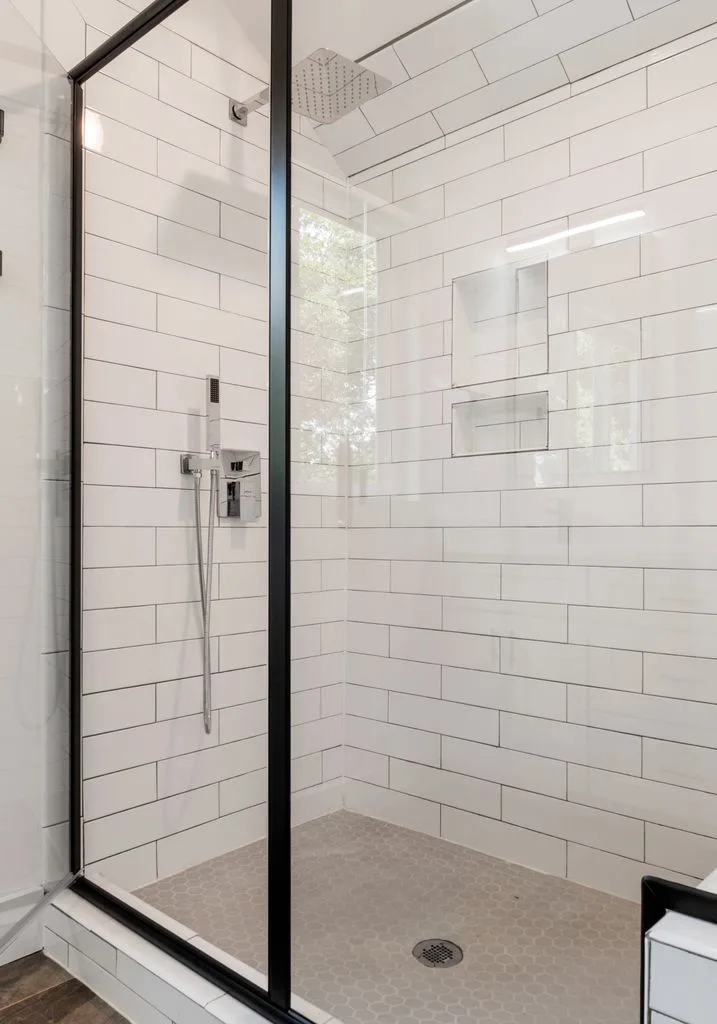
A black-framed glass shower brings the look of a steel factory window into the bathroom, and it is one of the most pinned monochrome features for good reason. The slim black grid divides the glass into panes, the dark frame outlines the shower like a picture, and the clear glass keeps the room feeling open while the black gives it structure. A custom black-framed shower screen runs $800–$2,500 depending on size, while a ready-made crittall-style panel starts around $400.
Pair the frame with white subway tile inside the shower and matte black shower fixtures so the dark reads as one continuous line from floor to ceiling. Keep the glass clean — black frames show water spots and soap film more than chrome does — and squeegee after showers to keep the grid looking sharp. If a full framed enclosure is beyond budget, a black-framed shower curtain rod and a black shower curtain give you the same graphic outline for under $100.
6. Matte Black Fixtures and Hardware
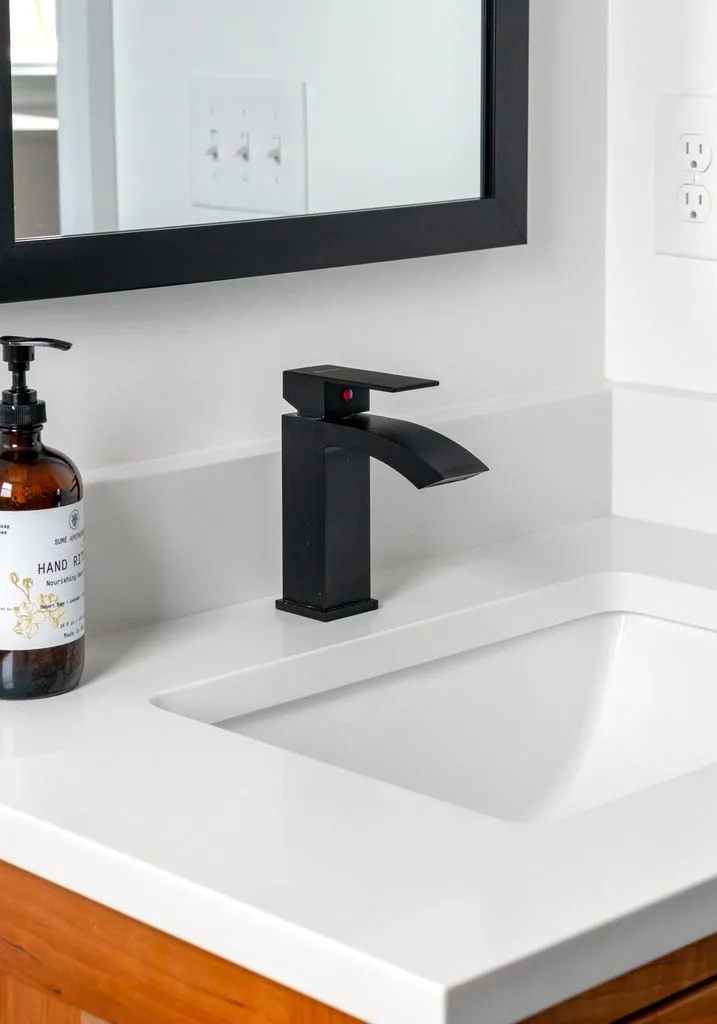
Matte black faucets, shower heads, towel bars, and cabinet pulls are the jewelry of a monochrome bathroom — small, affordable, and transformative. Swapping chrome for matte black instantly ties the whole room together, because the same dark finish repeats at the sink, the shower, and the door. A quality matte black faucet runs $120–$400, black cabinet pulls $4–$12 each, and a matching shower set $200–$600. The swap is a one-afternoon DIY job with a wrench and a little patience.
Keep the finish consistent — matte with matte, never mixed with polished black or chrome — and repeat it at least three times in the room so it looks planned rather than accidental. Matte black also hides water spots and fingerprints far better than chrome, which is a real gift in a hard-water home. Avoid the cheapest black fixtures, whose coating can chip and peel in steam; spend a little more on a reputable brand and the finish will last for years.
7. Black and White Marble
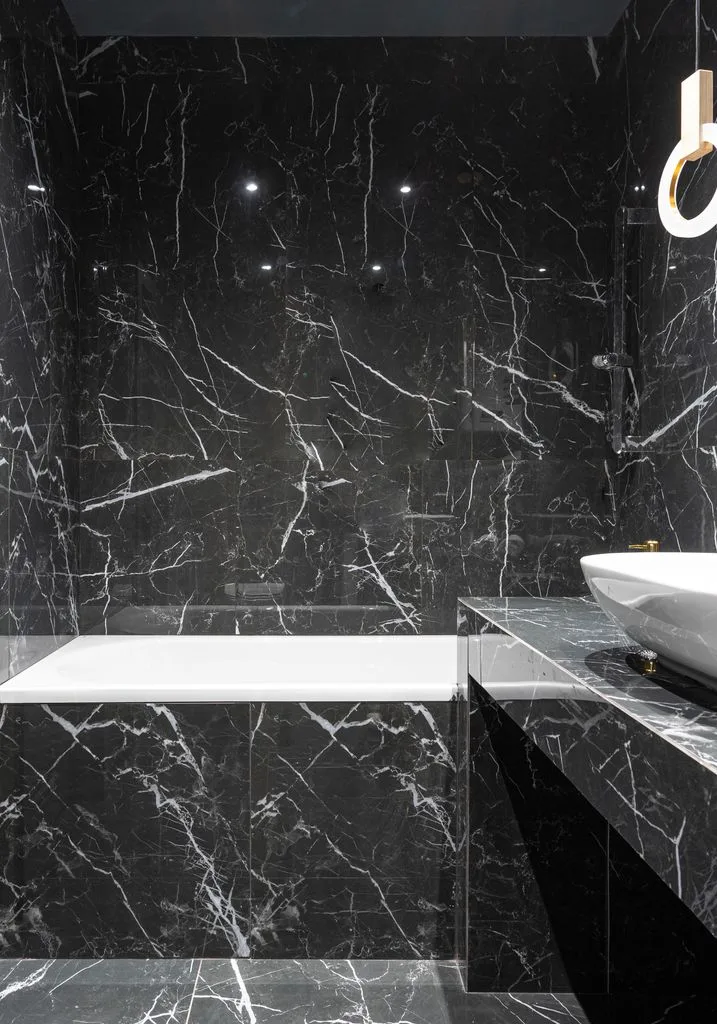
Black and white marble is monochrome at its most luxurious — the stone does the patterning for you, with veining that no tile can imitate. Use black marble with white veining for the vanity top or a feature wall, and white marble with gray-black veining for the floor or shower surround, so the two stones echo each other across the room. Real marble runs $60–$120 per square foot installed, while black-and-white marble-look porcelain gives you the same drama for $8–$20 per square foot with almost no maintenance.
This is the right move if you love the palette but want the bathroom to feel soft rather than graphic. The veining adds movement and texture, so the room never reads flat even though only two colors are present. Seal natural marble twice a year and wipe spills quickly, especially around the vanity where cosmetics and hair products leave marks. Porcelain marble-look tile needs nothing more than soap and water, which makes it the practical choice for a family bathroom.
8. Bold Black and White Patterned Walls
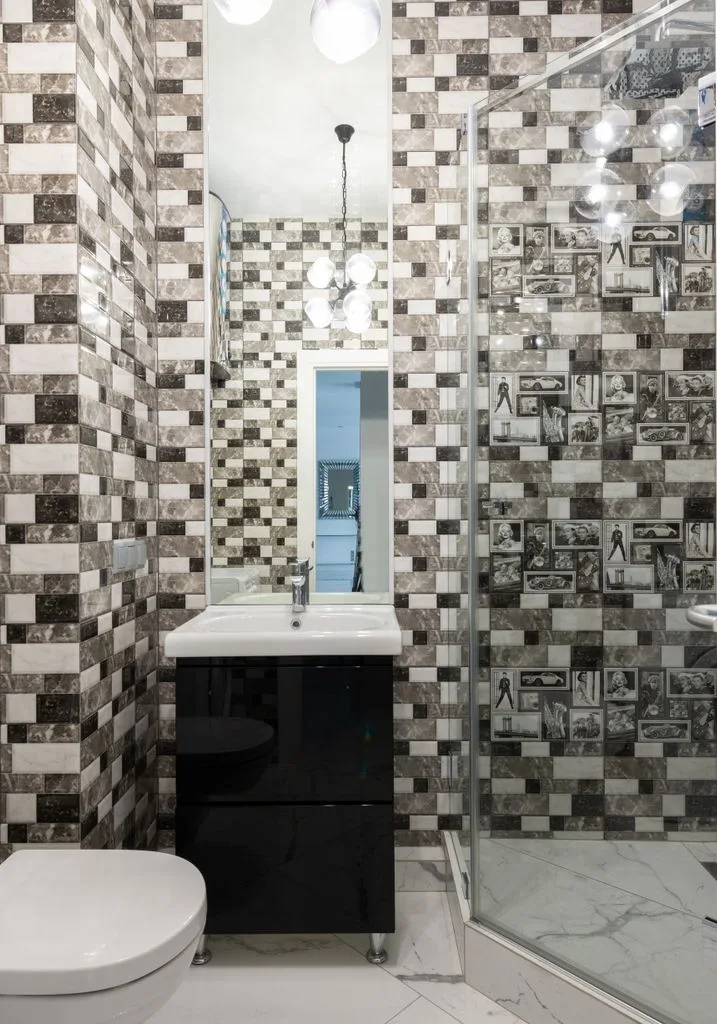
Patterned walls are where a monochrome bathroom gets its personality, and black and white is the safest palette to go bold with. A mosaic, geometric, or graphic patterned tile on one wall turns the shower or the vanity wall into a work of art, and because the colors are only black and white, the pattern can be as busy as you like without ever clashing. Patterned porcelain or mosaic tile runs $10–$25 per square foot, and a single feature wall in a small bathroom typically costs $300–$900 installed.
Confine the pattern to one wall and keep the other three plain white, so the room has a clear focal point instead of a visual shouting match. For layout and pattern inspiration, browse the black and white tile bath ideas on Houzz and notice how the best rooms pair one loud wall with quiet fixtures and plain floors. In a rental, bold black-and-white peel-and-stick wallpaper on one wall gives you the same graphic hit for $40–$100 and comes off without a trace.
9. A Bold Black Accent Wall
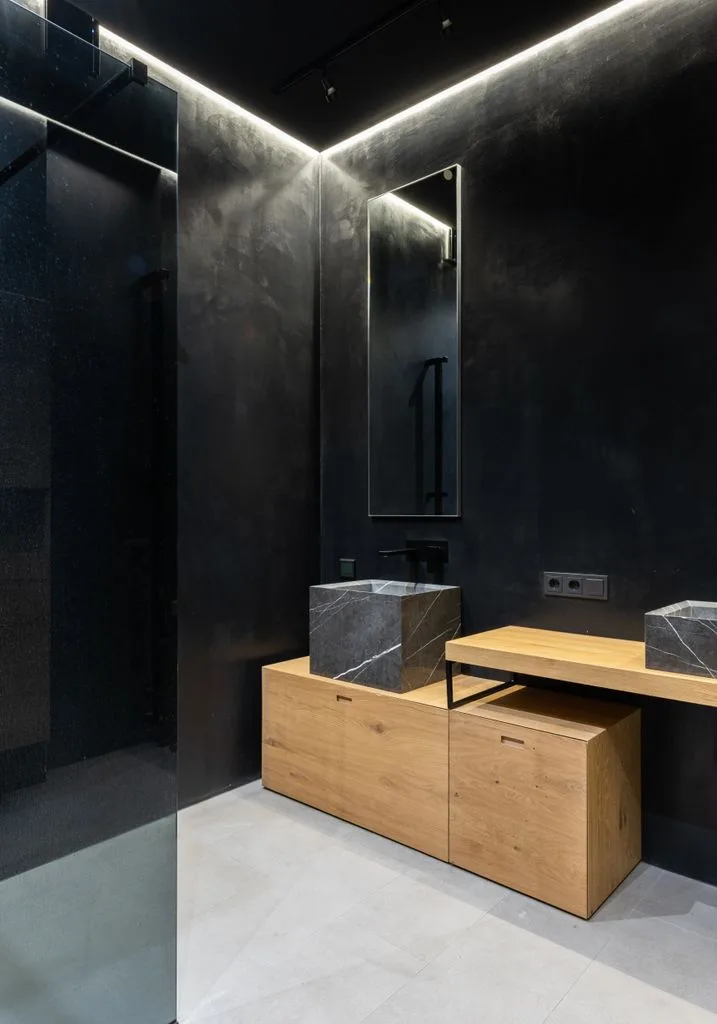
One black accent wall is the fastest way to give a white bathroom depth, and it costs less than a dinner out. Paint the wall behind the vanity or the tub in a deep matte black, and the white fixtures in front of it suddenly look brighter, sharper, and more expensive. A gallon of quality matte black bathroom paint runs $35–$60 and covers a small bathroom’s feature wall with room to spare.
Choose a black with a warm or neutral undertone rather than a blue-black, which can read cold and harsh in a bathroom’s artificial light. Paint a large swatch and watch it through a full day, because black shifts dramatically between morning sun and evening lamplight. Hang a large mirror or a white-framed print on the black wall to break up the dark, and keep the ceiling and the other walls bright white so the room never feels closed in.
10. White Walls with Black Trim and Doors
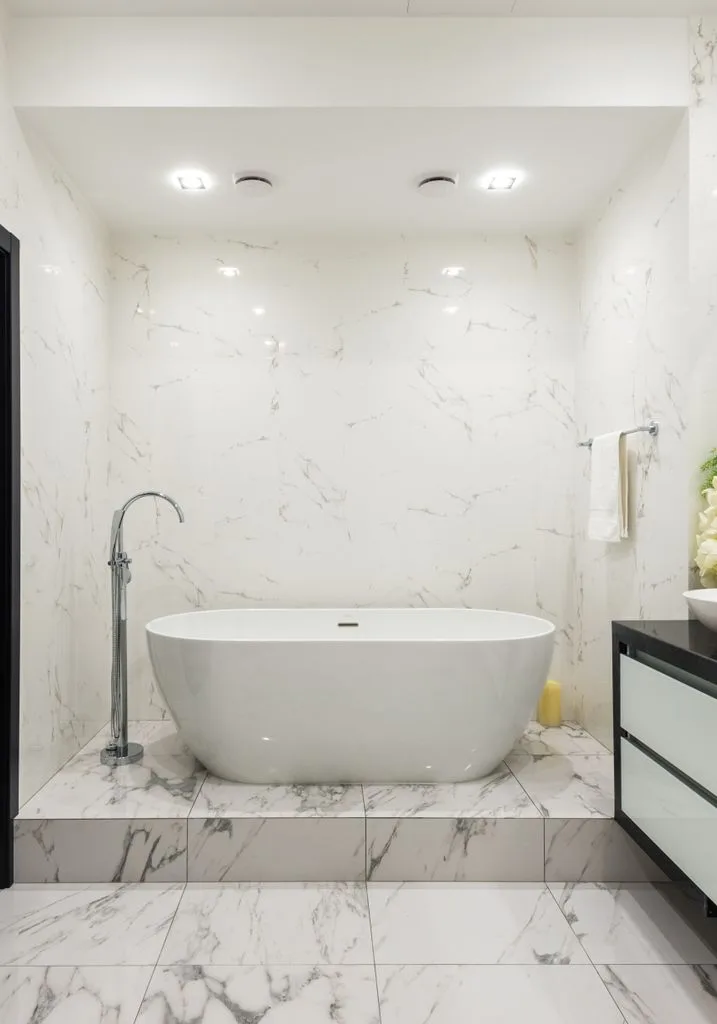
Black trim on white walls is the tailored suit of bathroom design: crisp, graphic, and quietly expensive-looking. Paint the door, the window frame, and the baseboards in matte black against bright white walls, and the room gains an architectural outline that makes even a plain bathroom look designed. The paint costs $30–$50 for the trim work, and the transformation takes a single weekend with a brush and a steady hand.
Keep the lines clean and the black consistent — one black for every trim piece, no mixing gloss levels — and let the contrast do the work. A black-framed doorway also frames the view into the bathroom from the hall, which is why this move photographs so well for Pinterest. If your bathroom has no natural woodwork to paint, a black-framed mirror and black towel hooks give you the same outlined effect without touching a single door.
11. Black and White Geometric Floor Tiles
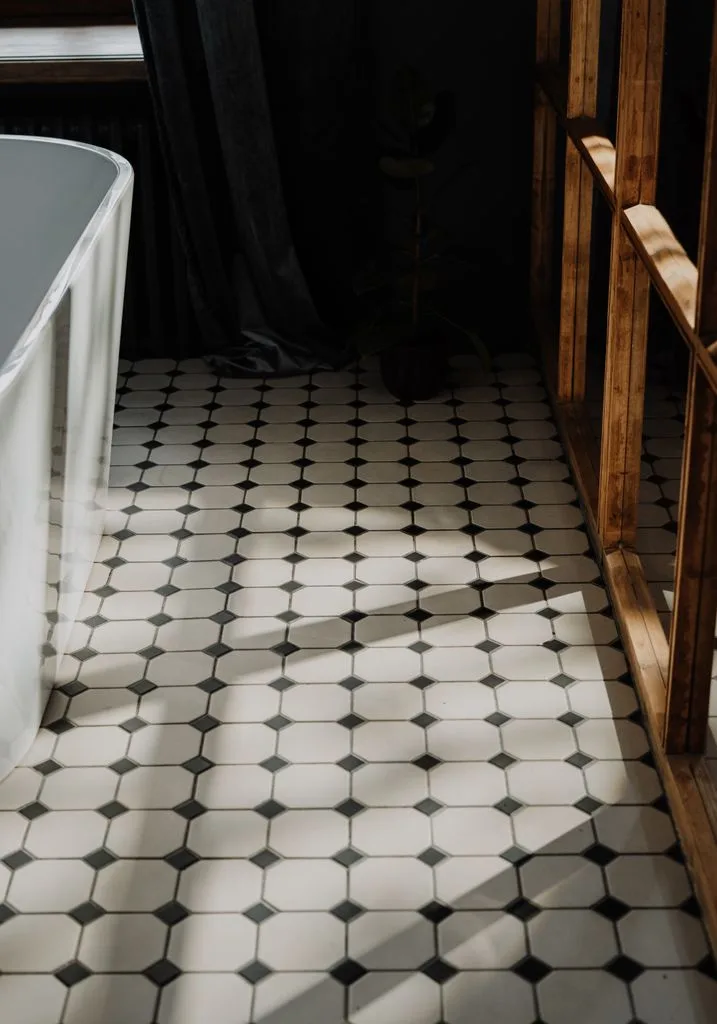
Geometric floor tiles — hexagons, octagons, diamonds, and fan shapes in black and white — give a monochrome bathroom its sense of craft. The pattern underfoot adds movement without adding color, and a small-scale geometric reads almost like texture from standing height, so the floor feels interesting rather than busy. Geometric porcelain tile runs $8–$18 per square foot, and a small bathroom floor typically costs $500–$1,500 installed.
Pair a patterned floor with plain white walls and a simple vanity, because the floor is already doing the talking. Small octagon-and-dot tile is the classic choice for a vintage-style bathroom, while large black hexagons feel bold and modern. Lay the pattern carefully — geometric tile shows every crooked line — and use a light gray grout that disappears into the white tiles instead of competing with the black ones.
12. Monochrome Artwork and Gallery Wall
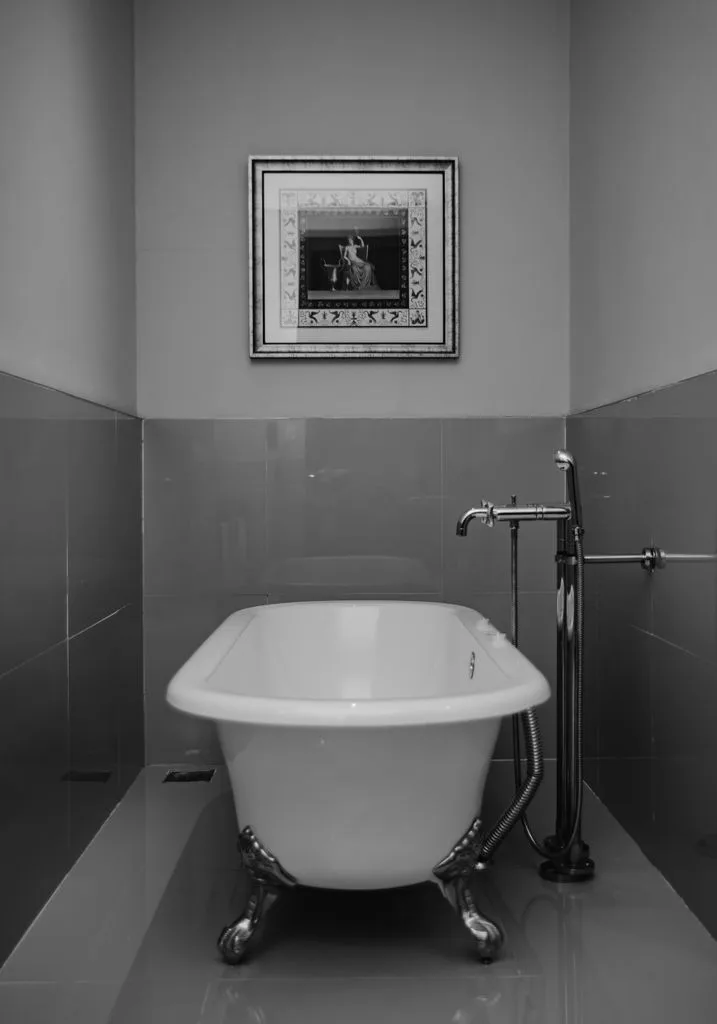
Black and white art is the easiest way to decorate a monochrome bathroom, because the palette is already decided for you. Hang one large black-and-white photograph above the tub, or build a small gallery wall of framed prints beside the vanity — botanical line drawings, architectural sketches, or vintage beach photographs all suit the scheme. Black frames with white mats cost $15–$40 each, and printable art keeps the whole wall under $100.
Keep the frames consistent — one frame style, one mat color — so the wall reads as a collection rather than a jumble. In a steamy bathroom, choose prints behind glass and avoid anything precious: humidity is unkind to paper, so inexpensive prints you can replace are smarter than originals. For proof that simple art transforms a monochrome bath on a tiny budget, see Apartment Therapy’s black and white bathroom makeover, where DIY paintings and a $100 budget turned a plain room into a favorite space.
13. Black and White Textiles
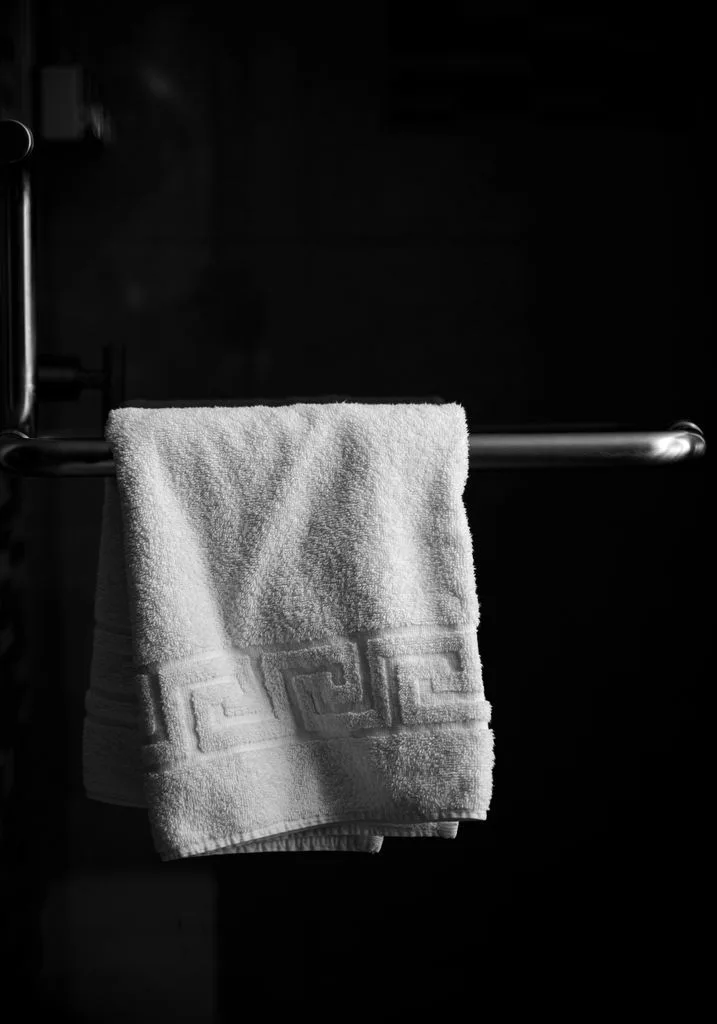
Textiles are the zero-commitment way to wear black and white, and they soften the room’s hard surfaces beautifully. A black shower curtain against white tile, white towels with a black border on a black towel bar, and a black-and-white striped bath mat give you the color story for $60–$150 total — and you can swap them out in minutes if you change your mind. Look for waffle-weave or Turkish cotton towels, which dry fast in a steamy room and look good hanging.
Choose washable fabrics and keep the pattern simple: one stripe, one border, or one graphic print, repeated twice in the room. A black shower curtain is the biggest textile in the room, so pick it first and let the towels and mat echo it. Rotate two sets — one mostly white, one mostly black — and the bathroom feels freshly styled every time you swap them, with no renovation at all.
14. Mirrors with Black Frames
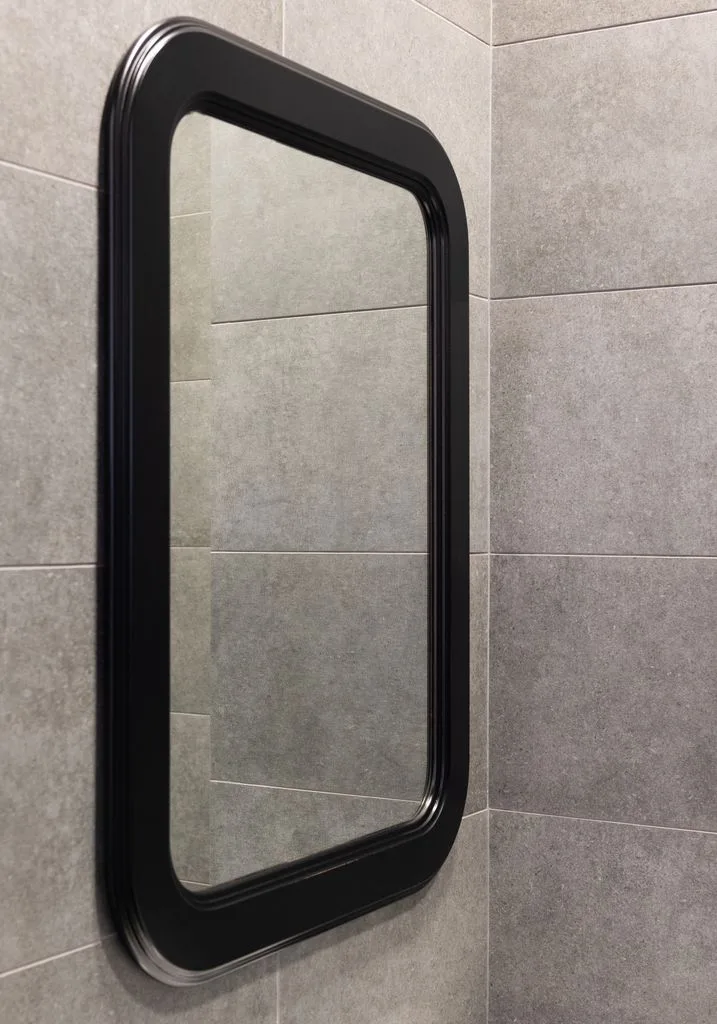
A black-framed mirror is the smallest change with the biggest return in a monochrome bathroom. The dark frame outlines the mirror like a picture, doubles the room’s light by bouncing it back, and ties together every other black element in the room — the faucet, the hardware, the trim. A round or arched black-framed mirror runs $60–$250 depending on size, and hanging it takes ten minutes and two screws.
Go large: a mirror that spans most of the vanity width makes a small bathroom feel twice as big, and a pair of matching black-framed mirrors over a double vanity looks tailored and intentional. Keep the frame slim — a thin black metal frame reads modern, while a thick black wood frame leans traditional — and match it to your faucet finish so the two blacks agree. Backlit black-framed mirrors add a soft glow that flatters skin and makes morning routines easier.
15. Open Shelving for Towels and Essentials
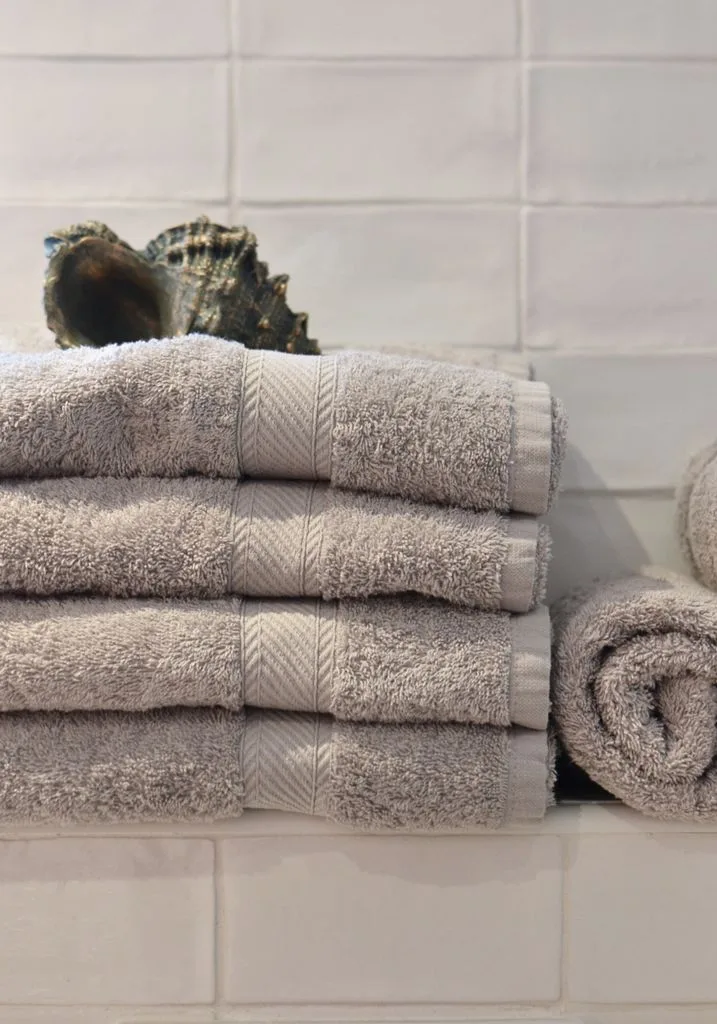
Open shelving in black or white turns storage into decoration in a monochrome bathroom. Two or three black metal shelves against a white wall, stacked with folded white towels and a few black baskets, give you storage you can see at a glance and a display that changes with the seasons. Black metal or painted wood shelves cost $40–$120 each, and a pair of woven or matte black baskets runs $20–$50.
Style shelves slowly and leave breathing room: rolled white towels, a jar of cotton balls, one small plant, a folded black hand towel for contrast. Fill only about two-thirds of each shelf and group objects in threes at different heights. Keep everyday clutter — medicines, cleaning products, spare toilet rolls — in a closed vanity or a lidded basket, so the open shelves stay calm and the room keeps its spa-like feel.
16. A Single Green Plant as the Only Colour
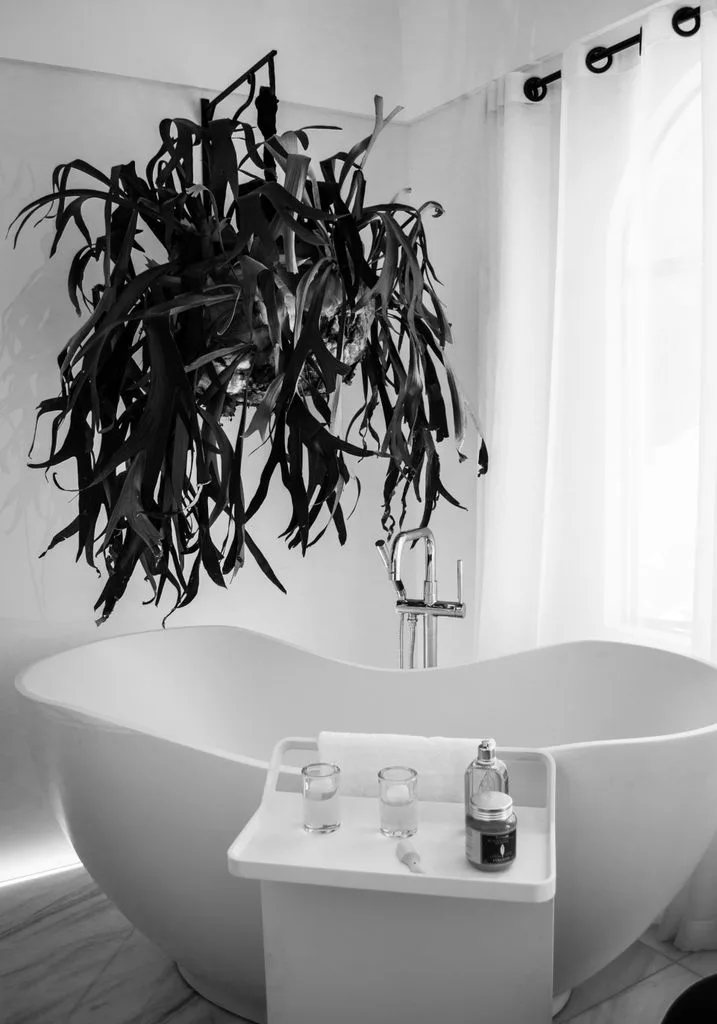
One green plant is the exception that proves the monochrome rule: in a room of only black and white, a single living green reads as a deliberate accent rather than a color clash. A trailing pothos on a shelf, a small fern on the vanity, or a tall snake plant in a black pot beside the tub adds life, softens the hard lines, and makes the black and white feel intentional instead of severe. Bathroom-friendly plants cost $10–$40, and a matte black pot ties the plant into the scheme for another $10–$20.
Choose plants that love humidity — pothos, ferns, peace lilies, and snake plants all thrive in steamy bathrooms — and keep it to one or two plants at most. The moment the green multiplies, the room stops being monochrome and starts being a garden, which is a different look entirely. A plant is also the most forgiving decoration in the room: if it outgrows its spot, move it, and the bathroom still looks finished.
17. Layered Lighting in Black and White
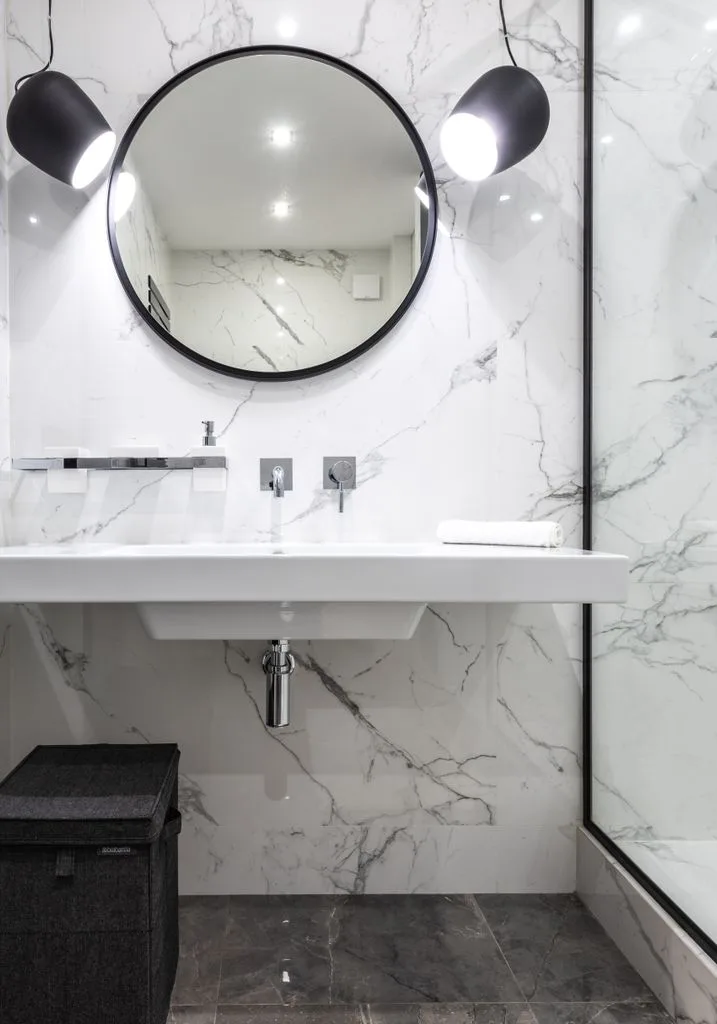
Lighting is what makes a monochrome bathroom feel warm instead of flat, and black fixtures are the way to keep the light itself on-palette. Pair black wall sconces beside the mirror with a black pendant or a flush-mount ceiling light, and put everything on dimmers so the room can shift from bright morning light to a soft evening glow. Black sconces run $50–$200 each, a black pendant $60–$250, and a dimmer switch about $25 installed.
Layer three kinds of light: bright, even light at the mirror for shaving and makeup, soft ambient light from the ceiling, and a low warm glow for baths. Warm 2700K bulbs are essential — cool white bulbs make black paint look blue-gray and white tile look clinical. If you already own chrome lights, swapping in black shades or black sconces is a one-hour job that changes the whole room after dark, which is when a monochrome bathroom looks its most dramatic.
How to Choose the Right Monochrome for Your Bathroom
Start by deciding how much black your bathroom can carry. Small, dark, or windowless bathrooms suit a lighter hand — white dominant, black in the fixtures, the mirror frame, and one patterned floor — because too much black in a small dark room feels heavy. Large, bright bathrooms can handle a black accent wall, black marble, or a black vanity, because daylight and white surfaces keep the contrast from closing in. Renters should weight every choice toward the portable: textiles, mirrors, shelving, and peel-and-stick tile, all of which move with you.
Then decide which black you are using. A soft matte black reads modern and calm, a glossy black reads glamorous and dramatic, and a charcoal gray-black sits between the two and forgives imperfect walls. Run the same three checks on every candidate purchase: is the finish matte or soft satin, does the black match the other blacks in the room, and will you still love it in five years? If a piece fails two checks, leave it, however pretty it looks in the shop.
Finally, respect your existing fixed elements. If your floor is warm wood, choose a black with a warm undertone and add a wooden bath tray or shelf to bridge the two. If your suite is bright white porcelain, almost any black will work — the white does the heavy lifting. And always sample: paint large swatches of your black on the wall and live with them for two days, checking them in morning light, midday sun, and evening lamplight, because black is famously changeable and a shade that looks perfect at noon can turn blue or brown by dinner.
Monochrome Black White Bathroom Ideas on a Budget
The under-$150 refresh. A black shower curtain, white towels with black borders, a black-framed mirror, and matte black cabinet pulls. This tier changes contrast, outline, and light — the three things guests notice first — for less than the cost of one new fixture. It is also fully reversible, which makes it the perfect test drive before you commit to paint or tile.
The $150–$800 room lift. Add a black vanity or repaint the existing one, swap all faucets and hardware for matte black, paint one accent wall, and add black open shelving with folded white towels. At this level the bathroom reads unmistakably monochrome black white, and every change is either cheap or reversible. Spend the money where your eyes land most: the vanity, the mirror, and the fixtures you touch every day.
The $800+ anchor investment. Spend on the pieces with the longest lives: a black-framed glass shower, a checkerboard or geometric tile floor, black marble surfaces, or a freestanding tub against a black wall. Buy these slowly and buy them once, starting with the single statement that matters most to you. Everything else in a monochrome bathroom is deliberately inexpensive — that contrast between one real anchor and many humble, found touches is exactly what makes the style feel rich rather than decorated.
Common Mistakes to Avoid
- Using too much black. A bathroom that is more black than white feels small, dark, and hard to clean. Keep white dominant — roughly two-thirds white — and let black be the accent.
- Mixing different blacks. Glossy black tile, matte black faucets, and blue-black paint in one room look accidental. Pick one black finish and repeat it.
- Pairing black with cool chrome. Chrome cools a monochrome bathroom down and makes the black look gray and washed out. Matte black hardware is the metal that keeps the contrast sharp.
- Adding a third strong color. A red towel set or a blue rug breaks the monochrome spell instantly. If you want color, use one green plant — and nothing else.
- Forgetting contrast in the details. Without white grout lines, white towels, or a white ceiling, black has nothing to stand against and the room turns flat and muddy. Every black needs a white partner.
- Skipping the swatch test. Black shifts more with light than almost any other color. Paint large swatches and live with them for two days before ordering paint, tile, or fixtures.
📌 Also Read:
Frequently Asked Questions
Does a black and white bathroom make a small bathroom look smaller?
Not if white dominates. Keep roughly two-thirds of the room white — walls, ceiling, sanitaryware, and towels — and use black for the floor pattern, the vanity, and the fixtures. White bounces light around and keeps the room bright, while the black adds depth and definition. A large black-framed mirror helps further, because it doubles the sense of space. The rooms that feel small are the ones where black takes over the walls as well as the floor.
Is a monochrome black white bathroom too cold or stark?
It can be, if the room is all hard surfaces and no warmth. The fix is texture and one warm note: a wooden bath tray or shelf, woven baskets, a green plant, or warm 2700K lighting. Matte finishes also help — matte black and soft-matte tile feel calm, while glossy black can feel harsh. With one warm element and layered lighting, a monochrome bathroom feels crisp and spa-like rather than cold.
What is the best black paint for a bathroom?
Choose a bathroom-specific paint in a matte or eggshell finish, with a neutral or warm undertone rather than a blue-black. Bathroom paints resist moisture and steam, which matters on walls near the shower and tub. Paint a large swatch and live with it for two days before committing, because black shifts with light more than any other color. Good starting points are soft blacks with a hint of warmth, which read as true black in the room without turning blue under artificial light.
Can I do a monochrome black white bathroom in a rental?
Yes — it is one of the most renter-friendly schemes because its best moves are portable. A black shower curtain, black-and-white towels, a black-framed mirror, black open shelving, and peel-and-stick checkerboard floor tiles create the whole look without paint or drilling. Keep the original hardware in a labeled bag, use removable tiles and hooks, and everything moves with you at the end of the lease.
How do I keep a black and white bathroom from looking dated?
Stick to the classics and skip the fads. Checkerboard floors, subway tile, black-framed showers, and marble have survived a century of trend cycles, while novelty patterns and themed accessories date quickly. Keep the palette strictly black and white, choose matte finishes over glossy ones, and let one statement — the floor, the vanity, or the accent wall — carry the room. Timeless monochrome is about restraint, not about owning every black-and-white object in the shop.
Conclusion
A monochrome black white bathroom is less about owning two colors than about using them with confidence: white to carry the light, black to draw the lines, and one warm note to keep the room feeling like home. Start where this guide starts — the floor, the vanity, or a single black-framed mirror — and add layers as you find them. Your bathroom does not need to be finished by Friday; the best monochrome bathrooms are built one thoughtful change at a time.
If these ideas sparked a plan, save this post to your bathroom decor board on Pinterest so it is waiting for you on your next tile run — and pin your favorite idea to share the timeless, high-contrast look.


